
News
Why Do Paid Campaigns Get Worse When Teams React to Every Daily Performance Change?
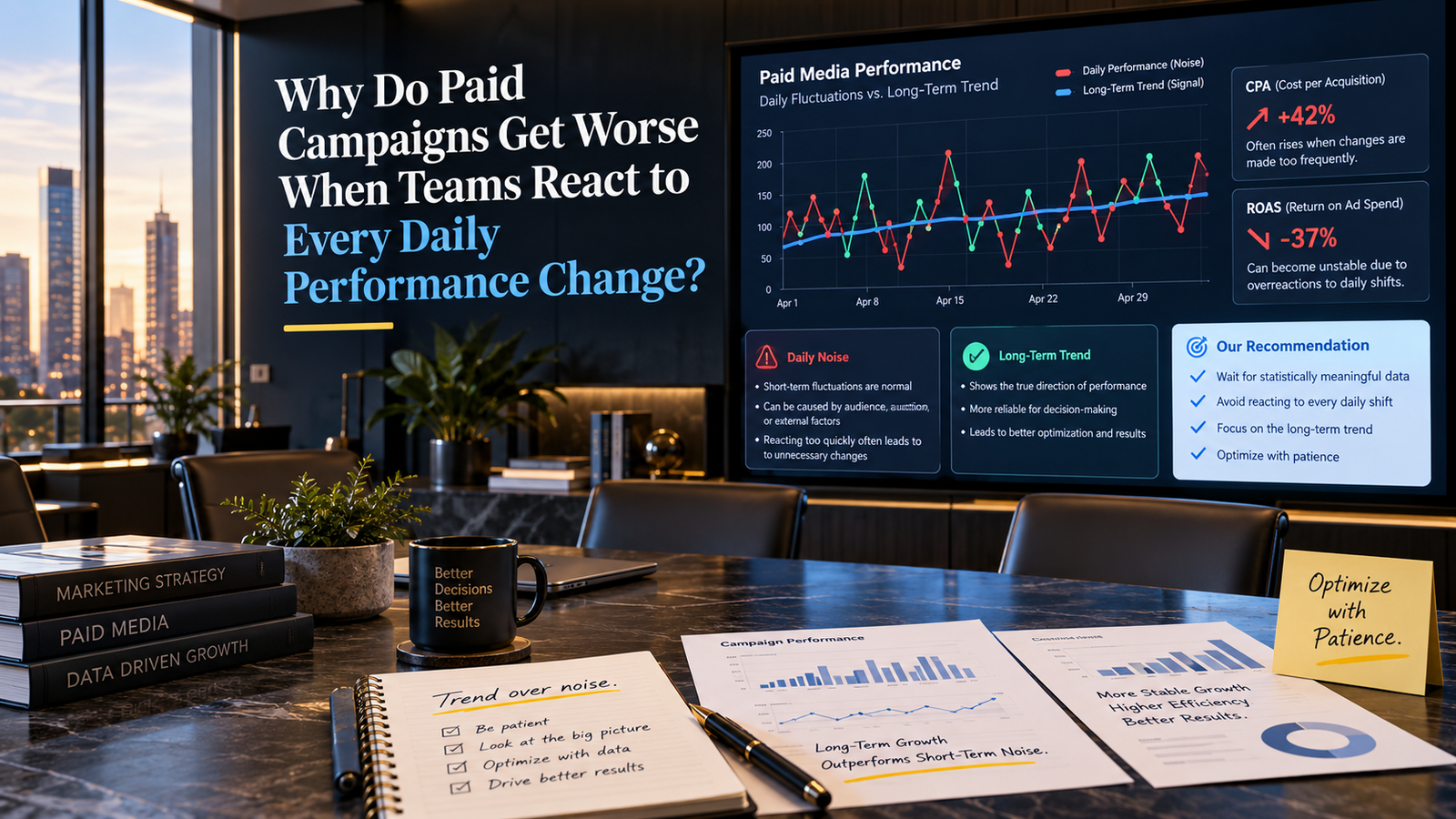
Paid advertising results rarely move in a straight line. A campaign may generate strong results on Monday, appear inefficient on Tuesday, and recover by the end of the week. These changes can make advertisers feel that immediate action is necessary.
Budgets are reduced, advertisements are paused, audiences are replaced, and campaigns are restructured before enough data has been collected. Frequent changes may create even more instability, making it difficult to understand what is genuinely improving performance.
Campaign performance volatility refers to the natural movement in advertising results over time. Some variation is expected because auctions, customer behaviour, competition, conversion delays, and daily demand are constantly changing.
A skilled performance marketing strategist knows when a performance change requires action and when a campaign needs more time to produce reliable evidence.
What Is Campaign Performance Volatility?
Campaign performance volatility is the fluctuation in metrics such as cost per click, conversion rate, cost per lead, revenue, and return on advertising spend.
These numbers can change from one day to another even when the campaign settings remain unchanged.
For example, a campaign may spend £200 and generate four customers one day, then spend the same amount without producing a customer the next day. This does not automatically mean the campaign has stopped working.
Purchases and qualified leads do not arrive at perfectly regular intervals. A small number of conversions can create large percentage changes, especially when the daily budget is limited.
Performance should therefore be judged across a period that reflects the campaign’s conversion volume and normal customer journey.
Why Do Daily Results Change So Much?
Several factors can cause short-term movement.
Advertising Auctions Change
Paid advertising placements are usually influenced by auctions. The number of competing advertisers, available users, bids, and predicted response rates can change throughout the day.
A campaign may reach customers at a lower cost during one period and face stronger competition during another.
Customer Demand Is Uneven
People do not buy at the same rate every day. Weekends, paydays, weather, news, holidays, and seasonal behaviour can influence demand.
The campaign may be stable while the market temporarily changes around it.
Conversions Can Be Delayed
A customer may click today and purchase several days later. If marketers judge the campaign before delayed conversions are recorded, recent performance can appear weaker than it really is.
This is particularly important for expensive products, considered services, and B2B offers.
Small Data Sets Exaggerate Movement
If a campaign normally generates two conversions per day, gaining or losing one conversion creates a large change in the reported average.
Larger data sets tend to produce more stable patterns, while low-volume campaigns require more patience and context.
How Can Frequent Changes Damage Performance?
Editing a campaign is not automatically harmful. Changes become a problem when they are made without sufficient evidence or a clear hypothesis.
Frequent adjustments can:
· Interrupt the collection of consistent data
· Make before-and-after comparisons unreliable
· Divide results across too many campaign versions
· Reduce the time available for learning
· Cause budgets to move toward temporary winners
· Prevent promising advertisements from proving their value
If an advertiser changes the audience, budget, creative, offer, and landing page together, it becomes almost impossible to identify which change affected the result.
My paid advertising services focus on finding the actual performance problem before recommending changes to campaigns, creative, offers, or funnels.
What Is the Difference Between a Signal and Normal Noise?
A signal is a meaningful pattern that suggests something has changed. Noise is short-term variation that does not represent a reliable trend.
One weak day is usually noise. A consistent decline across an appropriate period may be a signal.
Marketers should ask:
· Has the change continued for long enough?
· Is there enough conversion data?
· Did the audience, offer, website, or market change?
· Are tracking systems working correctly?
· Did lead quality decline as well?
· Is the change visible across several metrics?
· Has conversion delay been considered?
For example, rising cost per lead combined with lower click-through rates and increasing frequency may suggest creative fatigue. A higher cost per lead on one low-volume day provides much weaker evidence.
How Long Should a Campaign Run Before Changes Are Made?
There is no universal waiting period. The correct evaluation window depends on budget, conversion volume, sales-cycle length, and the size of the change.
A campaign generating many purchases each day can produce useful evidence quickly. A campaign generating a few high-value opportunities per month requires a longer view.
The decision window should also match the business cycle. If customers normally take 14 days to purchase, judging a campaign after three days will provide an incomplete picture.
Advertisers should establish evaluation rules before launch. This reduces emotional decisions when daily results become uncomfortable.
Reviewing relevant paid campaign case studies can also help businesses understand why performance should be evaluated through complete outcomes rather than isolated daily metrics.
Which Changes Require Immediate Action?
Patience does not mean ignoring serious problems.
Immediate action may be required when:
· Tracking suddenly stops recording conversions
· The landing page becomes unavailable
· Spending rises far beyond the intended limit
· The advertisement contains an error
· Leads are clearly fraudulent or irrelevant
· A policy issue affects delivery
· Customers report a misleading claim
· The promoted product is unavailable
These situations are operational problems rather than normal volatility.
In contrast, a temporary increase in acquisition cost may require observation before intervention.
How Can a Decision Framework Reduce Overreaction?
A simple framework gives marketers a consistent way to evaluate campaigns.
Step 1: Define the Main Business Metric
Choose the result that matters most, such as qualified leads, purchases, revenue, or cost per customer.
Supporting metrics can explain performance, but they should not replace the main objective.
Step 2: Set an Evaluation Window
Decide whether results will be reviewed weekly, biweekly, or after a minimum number of conversions.
Step 3: Record Every Major Change
Document when budgets, creative, audiences, offers, and landing pages are changed. Without this record, later analysis becomes unreliable.
Step 4: Change One Major Variable
Where practical, isolate the change. This makes it easier to determine whether the adjustment improved the result.
Step 5: Compare Customer Quality
A lower cost per lead is not an improvement if the new leads rarely become customers.
The results and reviews associated with a marketing specialist can provide additional context about whether their work is connected to meaningful business outcomes.
What Role Does Creative Testing Play?
Creative testing provides a structured alternative to reactive advertising changes.
Instead of replacing advertisements whenever daily results decline, marketers can test planned variations based on clear customer insights.
Variables may include:
· Opening hooks
· Customer problems
· Benefits
· Visual formats
· Offers
· Proof
· Calls to action
Each variation should answer a specific question. For example, does a demonstration communicate the benefit more effectively than a testimonial?
A planned testing process produces reusable knowledge. Random changes produce activity without necessarily producing understanding.
My creative portfolio shows how different visual approaches can support campaign messages and performance objectives.
How Should Teams Report Volatile Results?
Reports should include trends rather than presenting one day as the final conclusion.
Useful reporting may compare:
· Current period with the previous period
· Results by day of the week
· Seven-day and 30-day averages
· Platform conversions with CRM outcomes
· New customers with returning customers
· Lead volume with lead quality
· Revenue with gross profit
Important context should also be recorded, including promotions, website changes, holidays, stock problems, and sales-team capacity.
This helps decision-makers understand whether a result reflects advertising performance or a wider business condition.
Final Thoughts
Campaign performance volatility is normal, but unmanaged reactions can turn ordinary variation into a larger problem.
Businesses should not ignore meaningful declines, yet they should avoid rebuilding campaigns because of one weak day. The better approach is to define the main business metric, establish an evaluation window, check tracking, consider conversion delays, and make controlled changes based on a clear reason.
Stable decision-making creates better learning. It allows campaigns and creative tests to collect enough evidence while still protecting the business from genuine performance problems.
If your campaign results keep changing and you are unsure what requires action, you can discuss your advertising challenges before making another major adjustment.
Frequently Asked Questions
Is daily campaign volatility normal?
Yes. Auctions, customer demand, competition, and conversion timing can create daily changes even when campaign settings remain unchanged.
Should advertisers check campaigns every day?
Campaigns should be monitored for operational problems, but major strategic decisions should usually rely on a suitable amount of data.
Can frequent budget changes reduce stability?
They can. Repeated budget adjustments may change delivery patterns and make performance comparisons more difficult.
How can a business identify creative fatigue?
Possible signs include rising frequency, falling engagement, weaker conversion rates, and a sustained increase in acquisition cost.
When should an underperforming advertisement be paused?
It should be considered for pausing when sufficient data shows that it performs materially worse than alternatives or generates poor-quality outcomes.
Ready to Implement This in Your Ad Account?
Stop guessing why your Meta ads are stalling. Let's look inside your Ads Manager together and find the high-leverage growth bottlenecks.
Book 15-Minute Strategy Call →