News
Why Does Customer Acquisition Cost Rise When Your Ad Metrics Still Look Healthy?
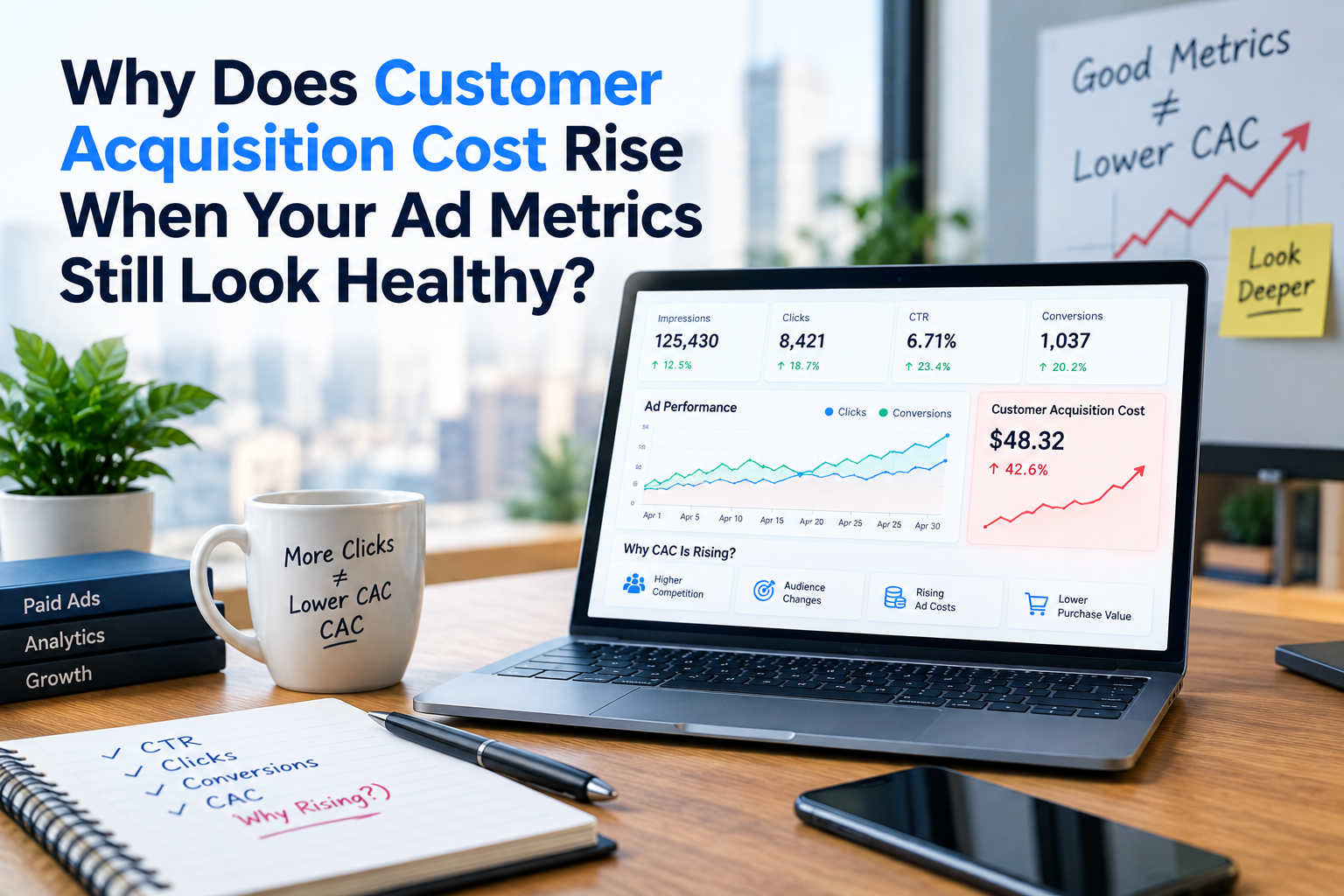
A campaign can show a strong click-through rate, affordable traffic, and plenty of engagement while the cost of acquiring a real customer continues to increase.
This happens because platform metrics describe only parts of the buying journey. An advertisement may attract attention without bringing suitable visitors. A landing page may generate leads who never answer calls. A campaign may report purchases without considering discounts, refunds, or fulfilment costs.
Understanding customer acquisition cost requires businesses to connect advertising activity with actual customers and revenue.
When acquisition becomes more expensive, the correct response is not always to reduce cost per click. The business must identify where efficiency is being lost between the first impression and the completed sale.
What Is Customer Acquisition Cost?
Customer acquisition cost, commonly called CAC, measures how much a business spends to gain a new customer.
A basic calculation divides total acquisition spending by the number of new customers acquired during the same period.
The calculation may include advertising spend, creative production, agency costs, software, and direct sales expenses. Businesses should define which costs are included and use the same method when comparing different periods.
Cost per lead and cost per purchase are not always the same as CAC. A person who submits a form is not yet a customer, while platform-attributed purchases may include returning buyers.
A reliable calculation should focus on genuinely new customers.
Strong Click Metrics Can Hide Weak Intent
A high click-through rate indicates that an advertisement encourages people to click. It does not prove that those visitors are likely to purchase.
Curiosity-based hooks, dramatic claims, or entertaining videos can attract attention from people who have little interest in the actual offer.
The landing-page conversion rate and customer quality should therefore be reviewed alongside click metrics.
A more specific advertisement may produce fewer clicks but attract visitors who better understand the product, price, and expected next step.
An experienced creative strategist can help connect advertising hooks with genuine customer needs rather than optimizing creative for attention alone.
Landing-Page Problems Increase Acquisition Cost
Even suitable visitors can be lost after the click.
The landing page may load slowly, especially on mobile devices. Its headline may not continue the promise made in the advertisement. Important information about pricing, delivery, process, or suitability may be difficult to find.
Every lost visitor increases the effective cost of acquiring those who eventually convert.
Businesses should examine the complete page experience, including form length, checkout steps, payment options, proof, and call-to-action placement.
Small design changes can help, but the main priority is clarity. Visitors should quickly understand what is offered, why it matters, and what action they should take next.
Cheap Leads Can Be Expensive Customers
Lead-generation campaigns are often optimized around cost per form submission.
If the form is very easy to complete, the platform may find more people who regularly submit forms. However, many may not meet the service requirements or have genuine buying intent.
For example, a campaign may reduce cost per lead from $30 to $15. That appears positive until the business discovers that only one in twenty cheaper leads becomes a customer.
Lead quality should be evaluated through contact rate, qualification, appointment attendance, sales conversion, and revenue.
Professional performance marketing services should connect these downstream outcomes with the campaigns and creatives that generated each enquiry.
Creative Fatigue Reduces Efficiency Over Time
An advertisement can perform well initially and gradually become less effective as more people see it.
The same audience may begin ignoring the message. Competitors may introduce stronger offers or similar creative concepts. The winning ad may also expand beyond the customer group most likely to respond.
Signs of fatigue can include rising frequency, weaker click response, lower conversion rates, or increasing acquisition costs.
Replacing the background colour or captions may not solve the issue if the central idea is already tired.
A healthy account needs new hooks, customer problems, proof, formats, and offers. Reviewing a diverse advertising creative portfolio can show how different messages and visual approaches support ongoing testing.
Scaling Reaches Less Efficient Customers
When a campaign budget increases, the advertising platform must find more conversion opportunities.
The first customers may come from the audience segments most likely to act. As spending grows, the campaign may need to reach people with lower intent or higher competition.
This means acquisition cost can rise even when the campaign setup has not changed.
Scaling should therefore be evaluated using marginal performance: what results did the additional spending generate?
A campaign that is profitable at $500 per day may not maintain the same efficiency at $2,000 per day. Budget increases should be controlled, and the business should monitor whether additional customers remain profitable.
The Offer May No Longer Feel Competitive
Campaign performance can decline when the offer loses relevance.
Customers compare price, convenience, proof, risk, delivery, features, and expected outcomes. A competitor does not need to sell the same product to provide an alternative solution.
The business should review whether the offer clearly communicates value. This may involve improving the package, clarifying guarantees, adding useful bonuses, changing payment options, or explaining the outcome more effectively.
Discounting is not always the best answer. Lower prices can reduce margins and make the acceptable CAC even smaller.
A strong offer improves the customer’s reason to act while protecting the economics of the business.
Sales Follow-Up Affects the True CAC
For service and B2B companies, acquisition does not end when a lead submits a form.
Slow response, inconsistent follow-up, unclear sales communication, and missed appointments can reduce the number of leads that become customers.
Marketing may appear to be the problem even when qualified prospects are being lost later in the process.
The business should measure response time, contact attempts, appointment booking, attendance, proposal acceptance, and closed revenue.
Sales feedback can also improve advertising. Common objections and misunderstandings can become new ad messages, landing-page sections, or form questions.
Acquisition efficiency improves when marketing and sales work as one connected system.
Tracking Errors Can Distort Acquisition Decisions
Missing or duplicated conversions can make CAC appear higher or lower than reality.
A website update may stop a purchase event from firing. Browser and server events may count the same order twice if they are not deduplicated. Returning customers may be reported as new acquisitions.
Businesses should compare platform data with analytics, CRM records, payment systems, and actual revenue.
Consistent tracking is especially important when comparing campaigns or deciding which one should receive more budget.
Relevant campaign case studies can help illustrate why performance measurement differs across ecommerce, SaaS, and lead-generation businesses.
Profit and Lifetime Value Define an Acceptable CAC
There is no universal “good” customer acquisition cost.
A business selling a high-margin subscription may afford to spend more than a company selling a low-margin, one-time product. Repeat purchases and customer retention also change the calculation.
CAC should be compared with contribution margin and customer lifetime value, not revenue alone.
A campaign may have a high acquisition cost but remain sustainable when customers stay for a long time. Another may appear affordable while attracting buyers who refund, cancel, or never purchase again.
Verified results and client reviews may provide useful context, but each business must set its own targets using real financial data.
How Can Businesses Reduce Acquisition Cost?
Reducing CAC requires identifying the weakest part of the customer journey.
If ad clicks are expensive, the audience or creative may need improvement. If clicks are affordable but conversion is weak, the landing page or offer should be reviewed. If leads are plentiful but sales are low, qualification and follow-up require attention.
Businesses should test one meaningful change at a time and record the result.
The objective is not always to achieve the lowest possible acquisition cost. It is to acquire suitable customers at a cost that supports profitable, sustainable growth.
Frequently Asked Questions
Is customer acquisition cost the same as cost per lead?
No. Cost per lead measures enquiries, while CAC measures how much is spent to acquire an actual customer.
What is a good customer acquisition cost?
A good CAC depends on margin, customer lifetime value, repeat purchases, operating costs, and business objectives.
Why does CAC rise when an advertising budget increases?
Larger budgets may require the platform to reach more expensive or lower-intent audience segments.
Can better creative reduce acquisition cost?
Yes. Relevant creative can attract suitable customers and communicate value clearly, but the landing page, offer, tracking, and sales process must also work effectively.
How often should CAC be reviewed?
It should be monitored regularly and evaluated over a period that matches the business’s normal buying cycle.
Final Thoughts
Healthy platform metrics do not always mean customer acquisition is efficient. Clicks, engagement, and leads must eventually connect with qualified customers, revenue, and profit.
Customer acquisition cost rises when friction appears anywhere between the advertisement and completed sale. By examining creative, landing pages, offers, lead quality, sales follow-up, tracking, and lifetime value together, businesses can identify the real source of increasing costs and make more responsible growth decisions.
Ready to Implement This in Your Ad Account?
Stop guessing why your Meta ads are stalling. Let's look inside your Ads Manager together and find the high-leverage growth bottlenecks.
Book 15-Minute Strategy Call →