News
Where Does a Paid Ad Creative Workflow Break Before Campaign Launch?
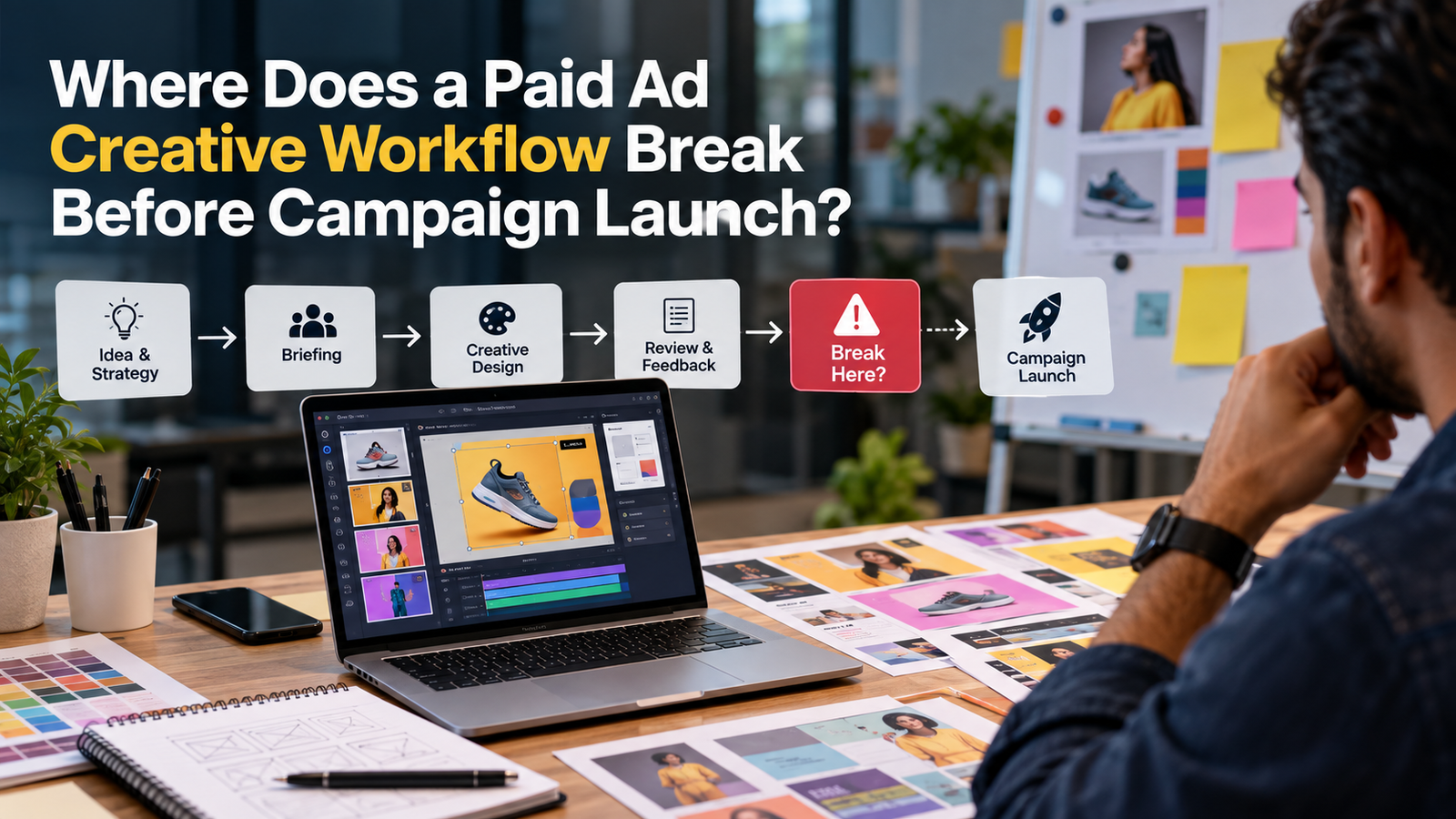
Paid campaigns need a steady supply of relevant creative. Yet many businesses start producing new ads only after performance has already declined.
A media buyer requests urgent variations, designers receive incomplete instructions, stakeholders provide conflicting feedback, and editors rush to deliver files before launch. The team may produce more content, but the advertisements are often minor versions of the same idea.
An organized paid ad creative workflow connects research, strategy, production, approval, launch, and performance analysis. It gives every person a clear role and ensures that campaign data improves the next production cycle.
The objective is not to create the largest possible number of assets. It is to produce a consistent supply of useful concepts that answer specific customer and campaign needs.
What Is a Paid Ad Creative Workflow?
A creative workflow is the complete process used to turn customer information into advertising assets.
It may include:
1. Customer and campaign research
2. Creative strategy
3. Concept prioritization
4. Brief development
5. Design or recording
6. Editing and review
7. Final approval
8. Campaign launch
9. Performance analysis
10. New production decisions
Each stage should provide clear information to the next one.
If research is weak, the brief may contain generic messages. If approval is slow, the campaign may launch after the offer changes. If results are not documented, the next creative batch begins with the same uncertainty.
The Workflow Often Breaks at Research
Creative production should begin with customer information, not design inspiration alone.
Useful sources include product reviews, customer interviews, sales calls, support questions, competitor advertising, search behaviour, and previous campaign results.
The team should look for recurring problems, desired outcomes, objections, use cases, and customer language.
Without this research, advertisements tend to rely on broad claims such as “save time,” “grow faster,” or “get better results.” These statements may be true but fail to explain why the offer matters to a specific customer.
An experienced creative strategist can turn research findings into clear advertising angles rather than asking designers to invent the strategy during production.
Strategy Must Come Before the Brief
A brief cannot solve a strategic problem that has not been discussed.
Before writing production instructions, the team should decide:
· Which customer segment is being addressed?
· What does that customer already know?
· Which problem or desire will lead the message?
· What proof supports the claim?
· What action should the viewer take?
· What is the advertisement testing?
One concept may focus on a customer objection, while another uses a product demonstration or case-study result.
These are meaningful strategic differences. Changing colours, captions, or music creates variations, but it does not necessarily introduce a new reason to buy.
Professional creative strategy services can help organize these decisions before production resources are committed.
Too Many Ideas Create a Prioritization Problem
Creative teams frequently receive more requests than they can complete.
Without prioritization, the loudest request or newest idea receives attention first. High-impact concepts may remain unfinished while the team works on small visual changes.
Ideas can be ranked using four practical factors:
· Expected business impact
· Confidence based on research
· Production effort
· Urgency of the campaign need
A concept supported by repeated customer objections may deserve priority over a trend with no clear connection to the offer.
The team should also balance new concepts with variations of existing winners. Depending entirely on new ideas creates unnecessary risk, while endlessly copying one winner limits future learning.
Briefs Fail When Instructions Are Scattered
Production becomes slow when information is divided across emails, chat messages, meetings, and voice notes.
One reliable brief should explain the audience, angle, main benefit, offer, proof, format, deliverables, brand requirements, and testing hypothesis.
It should also contain accurate product details and approved claims.
Creators need enough direction to understand the purpose without being forced to copy every sentence. Designers need to know which information must be prominent instead of being asked to fit every product feature into one image.
A good brief reduces avoidable revisions because stakeholders agree on the central message before production begins.
Production Needs Modular Assets
A single finished video provides limited flexibility. Modular production creates more usable material from the same session.
A creator can record several hooks, demonstrations, objection responses, proof statements, and calls to action as separate clips. Editors can then combine relevant pieces into controlled variations.
Static production can follow the same principle. The team can prepare different headlines, product images, proof elements, and layouts around one approved concept.
Modular production should not result in random combinations. Each final advertisement must still present a logical message.
Reviewing a diverse advertising creative portfolio can help teams understand how formats and visual approaches change across offers and campaign stages.
Approval Delays Can Make Creative Outdated
An advertisement may pass through marketing, legal, product, sales, and senior management before launch.
Multiple reviewers can protect accuracy, but unclear ownership creates delays and conflicting feedback.
The workflow should define:
· Who reviews strategy
· Who confirms product information
· Who checks brand requirements
· Who gives final approval
· How quickly each review should happen
Feedback should relate to the brief. Personal preferences such as “I do not like this colour” provide limited direction unless they connect to brand rules, readability, or campaign purpose.
Approving the concept and claims before full production reduces expensive late-stage revisions.
File Management Affects Campaign Learning
Poor file names make creative analysis difficult.
Names such as “Final-Ad-New-2” do not explain what the asset contains. A clear naming system can identify the concept, format, hook, audience, offer, and version.
For example:
Demo_TimeSaving_Hook02_Video15s_V1
This allows media buyers and strategists to connect results with the creative elements being tested.
The team should also store source files, approved exports, briefs, and results in organized locations. When a winning concept needs new variations, the required material can be found without rebuilding it.
Good asset management may seem operational, but it directly supports faster testing and stronger analysis.
Launch Should Include a Measurement Plan
Creative should not enter the campaign without a clear reason for being tested.
Before launch, the team should define the main metric and relevant supporting indicators.
A hook test may focus on early video retention and qualified clicks. An offer test may require conversion rate, sales quality, or customer acquisition cost.
Early metrics should not be separated from business outcomes. A video can hold attention while attracting people who never purchase.
The campaign should also receive enough budget and time to generate useful information. Stopping an ad after a few impressions or one weak day can create false conclusions.
Performance Data Must Return to the Creative Team
The workflow is incomplete if campaign results remain only with the media buyer.
Designers, copywriters, editors, and creators should learn which concepts, problems, formats, and proof elements influenced performance.
This does not mean sending them a large spreadsheet without explanation. Results should be translated into practical findings.
For example:
· Demonstrations attracted more qualified visitors.
· Price-based hooks produced clicks but weak lead quality.
· Customer stories improved conversion among warm audiences.
· Short videos held attention, but longer versions explained the offer better.
Relevant campaign case studies can also show how creative and media decisions work together across ecommerce, SaaS, and lead-generation campaigns.
A Workflow Should Protect Creative Variety
Efficient systems can accidentally make every advertisement look the same.
Templates save production time, but they should not replace concept development. If every asset uses the same hook, layout, and message, the campaign remains dependent on one idea.
The workflow should include planned variety across:
· Customer problems
· Benefits
· Awareness stages
· Formats
· Visual styles
· Proof types
· Offers
· Calls to action
Consistency should come from strategy and brand identity, not identical execution.
Verified results and client reviews can provide useful proof, but each campaign should select evidence relevant to its particular customer concern.
Common Workflow Mistakes
One common mistake is measuring output only by the number of assets produced. Ten nearly identical ads may provide less learning than three distinct concepts.
Another is beginning production before the offer and claims are confirmed.
Businesses also create delays when every stakeholder can request changes but nobody owns final approval.
Finally, results must be documented. Without a testing record, the team may repeat failed ideas or forget why successful concepts worked.
Frequently Asked Questions
How long should an ad creative workflow take?
The timeline depends on format, approval requirements, and production complexity. Clear ownership and complete briefs usually reduce delays.
Who should manage the creative workflow?
A creative strategist, performance marketer, project manager, or campaign lead may own it. The responsible person should connect strategy, production, and results.
How many new ads should a brand produce?
There is no fixed number. Production volume should reflect campaign spend, audience size, creative fatigue, testing priorities, and available resources.
Should media buyers approve creative?
They should contribute campaign context and performance insights. Final approval responsibilities should be clearly defined within the team.
Can small businesses build a creative workflow?
Yes. A simple shared brief, approval process, naming system, and results log can provide enough structure without expensive software.
Final Thoughts
A strong paid ad creative workflow removes confusion between research, strategy, production, approval, and campaign analysis.
It helps teams produce advertisements for clear reasons, launch them with measurable goals, and use results to guide future concepts.
When every stage provides useful information to the next, brands can reduce rushed revisions, maintain creative variety, and keep campaigns supplied with advertising that supports real business outcomes.
Ready to Implement This in Your Ad Account?
Stop guessing why your Meta ads are stalling. Let's look inside your Ads Manager together and find the high-leverage growth bottlenecks.
Book 15-Minute Strategy Call →