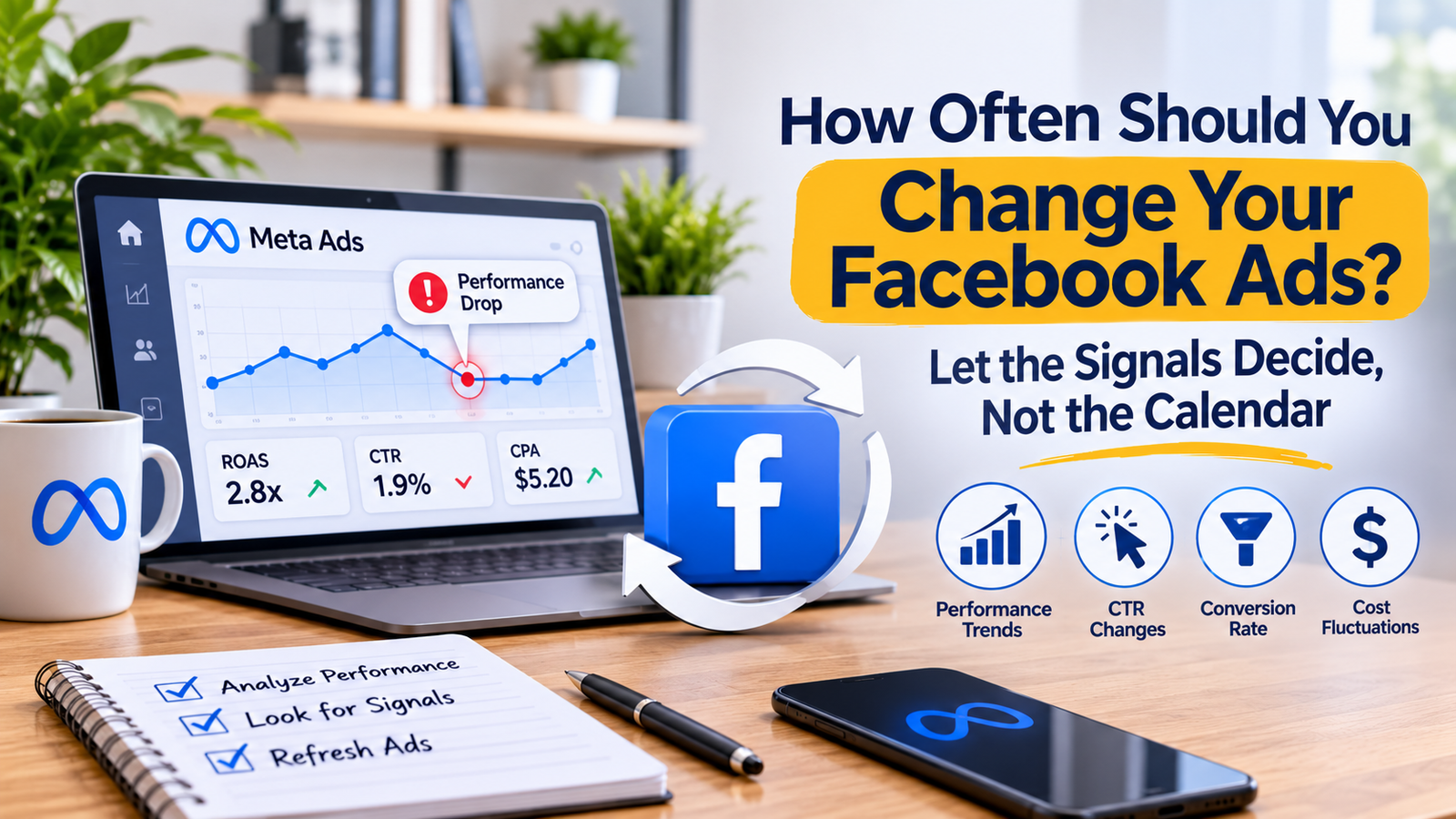
How Often Should You Change Your Facebook Ads? Let the Signals Decide, Not the Calendar
Ask ten advertisers how often to change Facebook ads and you will hear ten confident answers. Every week. Every two weeks. Every month. Never, if it works. The advice sounds precise, but none of it knows anything about your account.
The truth is that no fixed schedule fits every advertiser. The right timing depends on your audience size, your budget and how your ads are actually performing. This guide explains how to decide when to change an ad, how to change it and when to leave it alone.
Why a Fixed Schedule Does Not Work
Ads do not wear out on a timer. They wear out when the people who matter to you have seen them enough times to stop responding. That happens quickly for a small audience with a large budget, and slowly for a huge audience with a modest one.
Two accounts running the same ad for the same number of weeks can be in completely different situations. One may have barely scratched its audience. The other may have shown the ad to the same people dozens of times. A calendar rule cannot tell them apart. Your numbers can.
The Case for Not Changing Too Often
Many advertisers make the opposite mistake and change ads constantly. It feels productive, but it can backfire. Editing an ad in a significant way can restart the delivery system's learning, so a working ad may lose the stability it earned. Constant changes also make results impossible to read, because you never know which change caused which result.
If an ad is delivering steady results at a cost you can afford, leaving it alone is a perfectly good decision. Change should be a response to evidence, not a habit.
Signals That an Ad Is Wearing Out
Instead of watching the calendar, watch for patterns. No single sign is proof, but several together are a strong hint.
Click-Through Rate Softens
Often the first change is a gradual decline in the share of people who click. If an ad that used to earn steady clicks is slipping week after week, attention is probably fading.
Costs Creep Up
As engagement drops, you usually pay more for the same result. A steady rise in cost per click or cost per purchase, with no change to budget or audience, deserves attention.
Frequency Climbs
Frequency shows how many times the average person has seen your ad. A rising number is a useful warning light, especially in a small audience, but it is not a verdict on its own. Always read it alongside click rate and cost.
Your Best Ads Slow While New Ones Hold Up
If newer ads in the same account perform well while an older one declines, that contrast is a strong sign the old one is simply tired.
Rule Out Other Causes First
Not every dip means the creative is tired. Before changing anything, check that tracking still works, that nothing changed on the website, that the offer is unchanged and that the season or competition has not shifted. Weekends, paydays and holidays also move numbers for ordinary reasons.
Looking at trends over a week or two, instead of reacting to a single day, helps you separate real fatigue from normal movement.
Factors That Change How Often You Need New Ads
Audience Size
A large audience gives you more room, because exposure builds slowly. A small or tightly targeted one tires out much faster.
Budget
Higher budgets show ads to more people more often, which speeds up fatigue. If you raise spend, expect to need fresh creative sooner.
Type of Campaign
Retargeting audiences are small and see ads repeatedly, so they usually need more frequent refreshes. Prospecting campaigns reaching new people often last longer.
How Distinctive the Idea Is
A strong, specific message can hold attention for a long time. A generic one fades quickly.
What to Change When the Time Comes
When signals say an ad is tiring, the instinct is to tweak a color or swap a thumbnail. Small cosmetic changes rarely bring back attention, because the viewer still sees the same message. It helps to think of changes on a ladder, from small to big.
A New Opening
The cheapest meaningful change is a different first few seconds or a different headline, with the rest of the ad unchanged. Careful hook development often brings tired ads back to life, because the opening decides whether anyone sees the rest.
A New Format
The same idea in a new form, such as a video version of a winning image, feels fresh to people who have already seen the original.
A New Angle
The biggest refresh is a genuinely different reason to care. When an angle is exhausted, no amount of cosmetic work will help. Return to customer reviews and comments to find a new one.
Add New Ads Instead of Replacing Everything
A safer approach than swapping everything at once is to add new ads next to the existing ones and let results decide. The old ad keeps working while the new one proves itself, and you avoid the risk of removing something that still performs.
This also gives you a clear comparison. Because both ads run under similar conditions, you can see whether the new idea genuinely beats the old one. A structured approach to creative testing keeps those comparisons fair, because it changes one thing at a time and records what you learn.
Build a Rhythm Instead of Reacting
The best accounts do not wait for a crisis. They plan a steady flow of new ideas, so a replacement is ready the moment an ad starts to fade. That might mean a small batch of new ads every week or two for a busy account, and a slower cadence for a quiet one.
Keep a simple log of when each ad launched, how it performed and what you changed. After a few months, you will know how long your ads typically last, which is a far better guide than any article.
A Simple Decision Process
When an ad's numbers start to slip, first check tracking and context. Then look at the trend over more than a day or two. If click rate is softening, costs are rising and frequency is climbing together, it is probably time for fresh creative. Start with the smallest change that could help, add it alongside the old ad and give it enough time and budget to show a pattern.
If you are unsure whether a decline is fatigue or something deeper, a Facebook ads expert can review the account and tell you which it is.
You can also read real case studies to see how different accounts handled refreshes and what they learned.
Frequently Asked Questions
Is there a set number of weeks before I should change an ad?
No. Timing depends on audience size, budget and performance. Watch your own numbers instead of following a calendar.
Does editing an ad reset its performance?
Significant edits can restart the learning process and make results unstable. Smaller changes are less risky, and adding new ads alongside old ones is often safer than editing a working ad.
Should I turn off an ad as soon as it declines?
Not necessarily. Check whether the decline is real and sustained, and consider letting it run while a replacement proves itself.
How many new ads should I add at once?
A small group is usually enough, so each ad gets a fair share of delivery and results stay readable. The right number depends on your budget.
What if I do not have time to make new creative regularly?
Start simple. New openings and new versions of winning ideas take far less effort than building entirely new ads.
Final Thoughts
There is no magic number of days for changing Facebook ads. There is only evidence. Watch click rate, costs and frequency together, rule out other causes, start with the smallest change that could help and add new ads before removing old ones. Do that, and refreshing your ads becomes a calm routine instead of a guessing game.
If you would like help building a refresh routine for your own account, you are welcome to get in touch and talk through what to change and when.
Ready to Implement This in Your Ad Account?
Stop guessing why your Meta ads are stalling. Let's look inside your Ads Manager together and find the high-leverage growth bottlenecks.
Book 15-Minute Strategy Call →