How Does Ad-to-Landing-Page Message Match Improve Meta Ads Conversions?
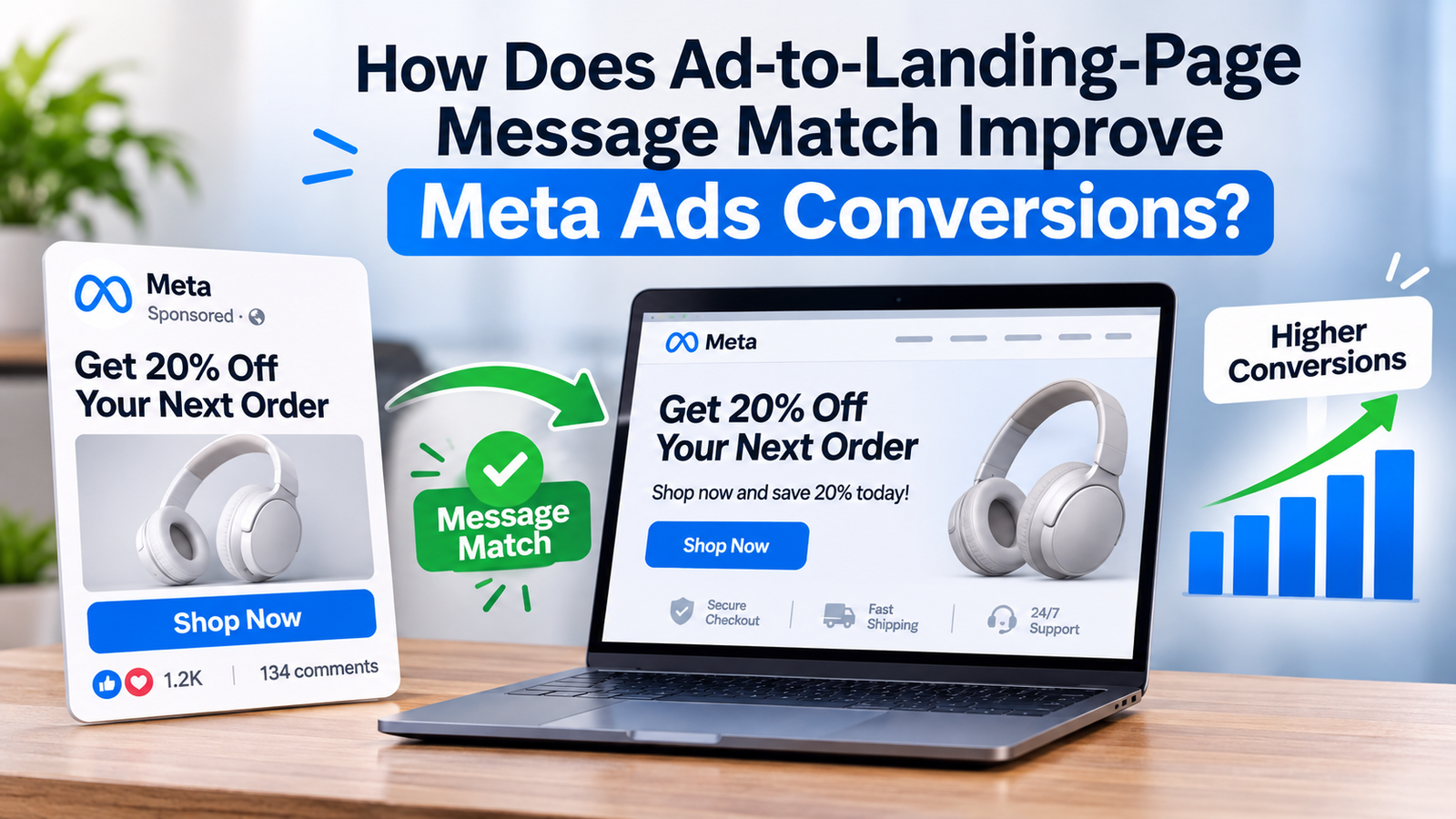
A successful Meta Ads campaign does more than attract clicks. It delivers an experience that matches what people expected when they clicked the advertisement. Ad-to-landing-page message match is the connection between an advertisement's promise and the content visitors see after reaching a website.
When messaging stays consistent, visitors can understand the offer quickly and decide whether to take action. When the advertisement and landing page communicate different things, confusion increases, and potential customers may leave without converting.
For brands investing in Meta Ads management, message consistency is an important part of improving campaign efficiency and turning paid traffic into meaningful business results.
What Is Ad-to-Landing-Page Message Match?
Ad-to-landing-page message match means aligning the advertisement's headline, offer, visuals, product benefits, and call to action with the destination page.
For example, imagine an ecommerce brand advertising a lightweight running shoe designed for everyday comfort. The advertisement highlights cushioning and flexibility, but the landing page opens with a generic footwear collection.
The customer must now search for the advertised product and determine whether the promised benefits are available.
A better experience directs visitors to a relevant page where the product, comfort benefits, and purchasing options appear immediately.
The objective is simple: deliver the experience promised by the advertisement without making visitors search for it.
Why Message Match Matters for Meta Ads Performance
Facebook and Instagram users often discover products while browsing rather than actively searching for something specific.
An advertisement creates interest by presenting a problem, benefit, offer, or desirable outcome. The landing page must continue that conversation.
When visitors encounter different messaging, their original motivation can disappear.
Poor message alignment may contribute to:
-
Higher landing page abandonment
-
Lower conversion rates
-
Increased customer acquisition costs
-
Reduced confidence in the advertised offer
-
More wasted advertising spend
However, message match is not a guaranteed way to lower costs. Pricing, targeting, competition, website usability, and product demand also influence campaign performance.
How Different Ad Promises Create Different Expectations
Not every advertisement should lead to the same landing page.
A product demonstration, promotional offer, and customer testimonial may attract different audiences with different questions.
Consider three advertising angles for the same skincare product.
Problem-focused advertisement: Highlights dry skin and discomfort. The landing page should explain the problem and demonstrate how the product addresses it.
Benefit-focused advertisement: Emphasizes hydration and convenience. The destination should communicate those benefits prominently.
Offer-focused advertisement: Promotes a limited-time discount. The corresponding landing page should clearly display the applicable offer and conditions.
These campaigns may promote an identical product, but their visitors arrive with different expectations.
A strong creative strategy helps connect advertising angles with suitable landing page experiences instead of treating every click as identical.
Common Landing Page Mistakes That Waste Advertising Traffic
1. Sending Every Advertisement to the Homepage
A homepage introduces the business, but it rarely answers every question created by a specific advertisement.
Visitors responding to a particular product benefit should not need to navigate multiple categories before finding the relevant information.
Dedicated product pages or campaign-specific landing pages often provide a clearer journey.
2. Hiding the Advertised Offer
If an advertisement promotes a discount, free consultation, or product bundle, visitors expect to find those details immediately.
An offer that appears only after extensive scrolling can create unnecessary uncertainty.
Keep the important information visible and make eligibility conditions easy to understand.
3. Using Different Headlines and Visuals
An advertisement featuring a particular product, audience, or outcome should lead to a page that feels connected.
Completely different imagery or messaging may cause visitors to question whether they reached the correct destination.
Matching the central promise is more important than copying every word or visual exactly.
4. Creating Unnecessary Conversion Steps
Long forms, unclear buttons, hidden prices, and complicated checkout processes can weaken campaign performance.
Even excellent message alignment cannot compensate for a frustrating buying experience.
How to Improve Ad-to-Landing-Page Message Match
Improving alignment requires coordination between advertising creative, website content, and conversion strategy.
Start With the Advertisement's Main Promise
Identify the primary reason someone would click the advertisement.
Is it affordability, convenience, product quality, a specific result, or a solution to a common problem?
The landing page should reinforce that motivation before introducing secondary information.
Keep Headlines Clear and Relevant
A visitor should recognize the connection between the advertisement and the landing page within seconds.
If an ad promises easier appointment scheduling, the page headline should communicate that same benefit rather than beginning with a broad company introduction.
Maintain Visual Consistency
Use recognizable products, imagery, and branding across the advertisement and destination page.
This creates familiarity and helps visitors confirm they are viewing the intended offer.
Match the Call to Action
The next step should reflect the action encouraged by the advertisement.
For example, an advertisement inviting users to request a consultation should not lead to a page where the consultation form is difficult to locate.
Optimize the Mobile Experience
Many Meta Ads interactions happen on mobile devices.
Check whether headlines, pricing, forms, and buttons remain accessible on smaller screens.
Fast loading, readable text, and simple navigation help maintain the visitor's attention.
How to Measure Whether Message Match Is Working
Message alignment should be evaluated through visitor behavior and business results rather than appearance alone.
Useful metrics include:
| Metric | What It Helps Evaluate |
|---|---|
| Landing Page Views | Whether clicks translate into successfully loaded pages |
| Conversion Rate | How effectively visitors complete the desired action |
| Cost Per Acquisition | How much advertising spend is required for each acquisition |
| Add-to-Cart Rate | Whether ecommerce visitors show purchasing interest |
| Form Completion Rate | How effectively lead generation pages convert visitors |
| Revenue Per Visitor | The commercial value generated from website traffic |
These metrics should be reviewed together.
For example, a lower acquisition cost is not necessarily beneficial if lead quality or average order value declines.
A qualified performance marketing specialist can evaluate advertising performance alongside landing page behavior to identify where customers lose interest.
Why Creative Testing Should Include Landing Pages
Businesses frequently test different advertising headlines, videos, and audiences while leaving their landing pages unchanged.
This creates a measurement gap.
An advertisement may attract qualified visitors but fail because the destination does not address their expectations.
Testing different landing page headlines, product explanations, offers, and calls to action can reveal whether the problem exists before or after the click.
For reliable comparisons, change one major element at a time when practical and evaluate results using sufficient data.
Reviewing relevant advertising case studies can also provide perspective on how creative execution and customer journeys contribute to broader campaign outcomes.
When Should Businesses Review Message Match?
Message alignment deserves attention whenever advertising performance changes unexpectedly.
It is particularly useful to review when:
-
Click-through rates remain healthy but conversions decline.
-
A new advertising angle generates traffic without purchases.
-
Promotional campaigns receive interest but produce weak sales.
-
Mobile visitors abandon pages more frequently than desktop visitors.
-
Advertising costs increase despite consistent audience targeting.
Before increasing campaign budgets, businesses should determine whether their landing pages can convert the traffic they already receive.
Final Thoughts
Ad-to-landing-page message match connects advertising expectations with the experience customers receive after clicking.
Strong alignment makes offers easier to understand, reduces unnecessary friction, and helps visitors move toward a meaningful decision.
Businesses should evaluate advertisements and landing pages as connected parts of one customer journey.
If your campaigns generate attention but struggle to convert visitors, reviewing both creative messaging and website experience may reveal opportunities for improvement.
For a personalized review of your advertising challenges, contact Zohaib Raja to discuss your Meta Ads strategy and conversion goals.
Frequently Asked Questions
What is message match in Meta Ads?
Message match means keeping the central promise, product information, offer, and intended action consistent between a Facebook or Instagram advertisement and its landing page.
Does landing page message match improve conversion rates?
It can improve conversion rates by reducing confusion and helping visitors find the information they expected. Results depend on the offer, traffic quality, website experience, and other campaign factors.
Should every Meta Ad have a separate landing page?
Not necessarily. Advertisements with similar promises and audience expectations can share a relevant landing page. Different offers or customer motivations may benefit from separate destinations.
How can businesses identify poor message match?
Compare advertising messages with landing page headlines, visuals, offers, and calls to action. Review visitor behavior, conversion rates, and abandonment patterns to identify possible gaps.
Is message match important for ecommerce and lead generation?
Yes. Ecommerce campaigns need consistency between product advertising and purchasing pages, while lead generation campaigns need alignment between the advertised service and the inquiry or booking experience.
Ready to Implement This in Your Ad Account?
Stop guessing why your Meta ads are stalling. Let's look inside your Ads Manager together and find the high-leverage growth bottlenecks.
Book 15-Minute Strategy Call →