
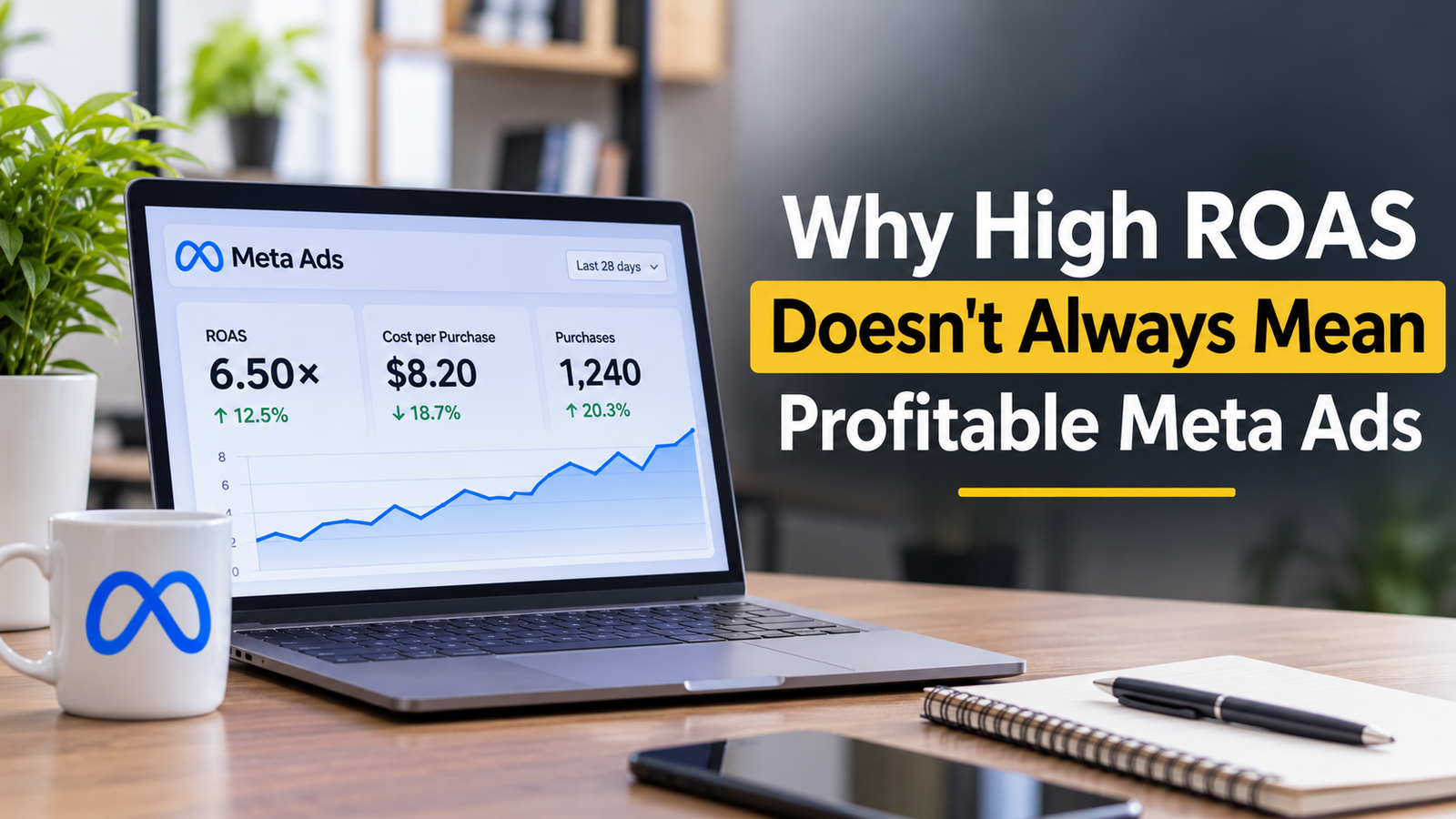
A high return on ad spend looks impressive in a marketing report. But does it mean your business is actually making money? Not necessarily. Meta Ads profitability depends on more than revenue generated from advertising. Product margins, customer acquisition costs, fulfillment expenses, and attribution accuracy all influence whether your campaigns produce sustainable returns.
Many businesses celebrate strong ROAS while overlooking the expenses behind every conversion. Understanding the difference between advertising performance and actual business profit helps marketers make smarter spending decisions.
With a structured Meta Ads management strategy, businesses can evaluate campaigns beyond surface-level metrics and focus on meaningful commercial outcomes.
What Does ROAS Actually Tell You?
Return on ad spend (ROAS) measures the revenue attributed to advertising compared with the amount spent on those ads. It is one of the most widely used performance indicators in Facebook and Instagram advertising.
For example, imagine spending $1,000 on Meta Ads and generating $4,000 in attributed revenue. Your reported ROAS is 4.0. That sounds promising, but the calculation does not include product manufacturing, shipping, payment processing, returns, or operational expenses.
A business with strong profit margins might perform well at 4.0 ROAS. Another business selling low-margin products could struggle to remain profitable at the same return. ROAS provides useful information, but it cannot independently measure business profitability.
Why High ROAS Can Hide Poor Campaign Performance
Product Margins Change the Equation
Every product has different economics. A premium product with healthy contribution margins may support higher acquisition costs than a heavily discounted item.
Consider two businesses generating the same advertising revenue. One retains 60% of revenue after variable product and fulfillment costs, while the other retains only 20%. Even with identical ROAS, their financial outcomes will differ significantly.
This is why advertisers should calculate contribution margins before deciding whether a campaign deserves additional investment.
Attribution Can Overstate Advertising Impact
Meta attributes conversions according to the selected reporting settings and available tracking information. However, not every attributed purchase necessarily represents a customer who discovered the brand through that specific advertisement.
Existing customers might see retargeting ads before purchasing products they already intended to buy. Different advertising platforms may also claim credit for overlapping customer journeys.
Effective performance marketing services should therefore evaluate platform reporting alongside actual business revenue and customer acquisition data.
Discounts Can Reduce Real Returns
Promotional campaigns frequently increase conversion rates by offering attractive discounts. However, higher sales volume does not automatically translate into greater profit.
A campaign offering 30% off might generate impressive ROAS while leaving limited margin after advertising and operational expenses. Advertisers need to compare promotional revenue against actual contribution profit rather than judging success purely by purchase volume.
Understand Your Break-Even ROAS Before Scaling
Break-even ROAS helps businesses estimate the advertising return required to cover costs. A simplified calculation is:
Break-Even ROAS = 1 ÷ Contribution Margin Before Advertising
If a business retains 40% of revenue after variable costs, its simplified break-even ROAS is 2.5. That means every dollar spent on advertising must generate approximately $2.50 in revenue to cover those variable expenses and advertising costs.
However, this calculation does not automatically include fixed overhead, taxes, or other financial obligations. Businesses should establish a target ROAS above their relevant break-even threshold, accounting for their desired profit and cost structure.
Customer Acquisition Cost Matters More Than Cheap Clicks
Customer acquisition cost (CAC) measures how much a business spends to acquire a customer. An advertisement generating inexpensive clicks may appear efficient, but those clicks become less valuable when visitors fail to purchase.
Suppose Campaign A generates 2,000 clicks and 20 customers, while Campaign B generates only 800 clicks and 40 customers. Campaign B might deliver stronger commercial performance despite receiving less traffic, depending on advertising spend and customer value.
This is why successful Facebook Ads management requires connecting campaign metrics with actual customer acquisition outcomes. Track acquisition costs, customer quality, average order value, and repeat purchase behavior together.
How Creative Strategy Influences Profitability
Creative strategy does more than increase engagement. Effective advertising communicates the right message to people who are likely to become valuable customers.
An attention-grabbing advertisement may produce thousands of reactions without generating meaningful purchases. A more targeted creative might receive less engagement but attract buyers with stronger purchase intent.
Advertisers should develop different creative angles based on customer motivations, objections, and buying stages. For example, one advertisement might demonstrate product benefits while another addresses pricing concerns or provides customer testimonials.
A qualified creative strategist can connect audience research, advertising messages, and campaign performance to identify which approaches deserve continued investment. The objective is not simply to attract attention. It is to attract relevant attention that can produce profitable customer relationships.
Improve Conversion Tracking and Reporting Accuracy
Incomplete tracking makes profitability harder to evaluate. Meta Pixel and Conversions API can help advertisers capture conversion signals, although neither guarantees complete measurement.
Businesses should also compare advertising reports with ecommerce transactions, CRM records, and financial information. A practical measurement process includes checking purchase events, identifying duplicate conversions, reviewing attribution settings, and comparing reported revenue with completed orders.
Where possible, analyze new and returning customers separately. This helps businesses distinguish customer acquisition performance from revenue generated by existing relationships.
Better tracking supports informed decisions, but advertisers should still expect some differences between platform attribution and actual business results.
When Should You Increase Your Meta Ads Budget?
Increasing advertising spend makes sense when performance remains financially sustainable and there is sufficient evidence that additional investment can produce acceptable returns.
Before scaling, review contribution margins, acquisition costs, conversion consistency, and available creative variations. A campaign performing well with a small budget might become less efficient when spending increases because the additional audience is harder to convert.
Rather than doubling budgets automatically, test controlled increases and monitor how marginal acquisition costs change. If performance deteriorates, investigate audience saturation, creative fatigue, landing-page issues, and offer competitiveness.
An experienced Meta Ads specialist can help connect creative testing with budget decisions and business profitability targets.
Build a Profit-Focused Meta Ads Measurement System
Profitable advertising requires consistent measurement rather than isolated performance snapshots. Start by calculating your product-level contribution margins. Next, establish acceptable acquisition costs and realistic advertising return targets.
Review campaign performance using both advertising metrics and financial outcomes. Separate prospecting campaigns from retargeting activity when evaluating customer acquisition efficiency.
Finally, document the relationship between advertising spend, conversions, revenue, and contribution profit. This approach makes it easier to identify campaigns generating sustainable value instead of simply reporting attractive platform numbers.
Businesses that understand their economics can make clearer decisions about testing new creatives, improving offers, and increasing advertising budgets.
Frequently Asked Questions
1. Is 4.0 ROAS good for Meta Ads?
It depends on product margins, operating expenses, and profitability targets. A 4.0 ROAS can be profitable for one business and insufficient for another.
2. What is break-even ROAS?
Break-even ROAS is the advertising return required to cover the costs included in your calculation without generating a profit or loss.
3. Why is my ROAS high but profit low?
Low margins, shipping expenses, discounts, returns, and attribution differences can reduce profit despite strong reported ROAS.
4. How can I improve Meta Ads profitability?
Improve creative relevance, landing-page conversions, customer acquisition efficiency, contribution margins, and tracking accuracy.
5. Should I scale campaigns with high ROAS?
Scale only after checking profit margins, acquisition costs, conversion consistency, and whether additional spending remains financially sustainable.
Final Verdict
High ROAS is useful, but it should never be the only measure of advertising success. Meta Ads profitability comes from understanding how campaign spending affects real business economics.
Businesses should evaluate contribution margins, acquisition costs, tracking accuracy, and customer value before making major budget decisions. A campaign generating moderate ROAS with sustainable profit may be more valuable than one reporting exceptional returns without meaningful financial gains.
For businesses looking to improve their advertising decisions, Zohaib Raja provides creative strategy and performance marketing expertise focused on connecting campaign execution with measurable business outcomes.
Ready to Implement This in Your Ad Account?
Stop guessing why your Meta ads are stalling. Let's look inside your Ads Manager together and find the high-leverage growth bottlenecks.
Book 15-Minute Strategy Call →