
Why Should You Run a Meta Ads Audit Before Rebuilding Your Campaigns?
By Zohaib Raja
•
September 21, 2026
•
6 min read
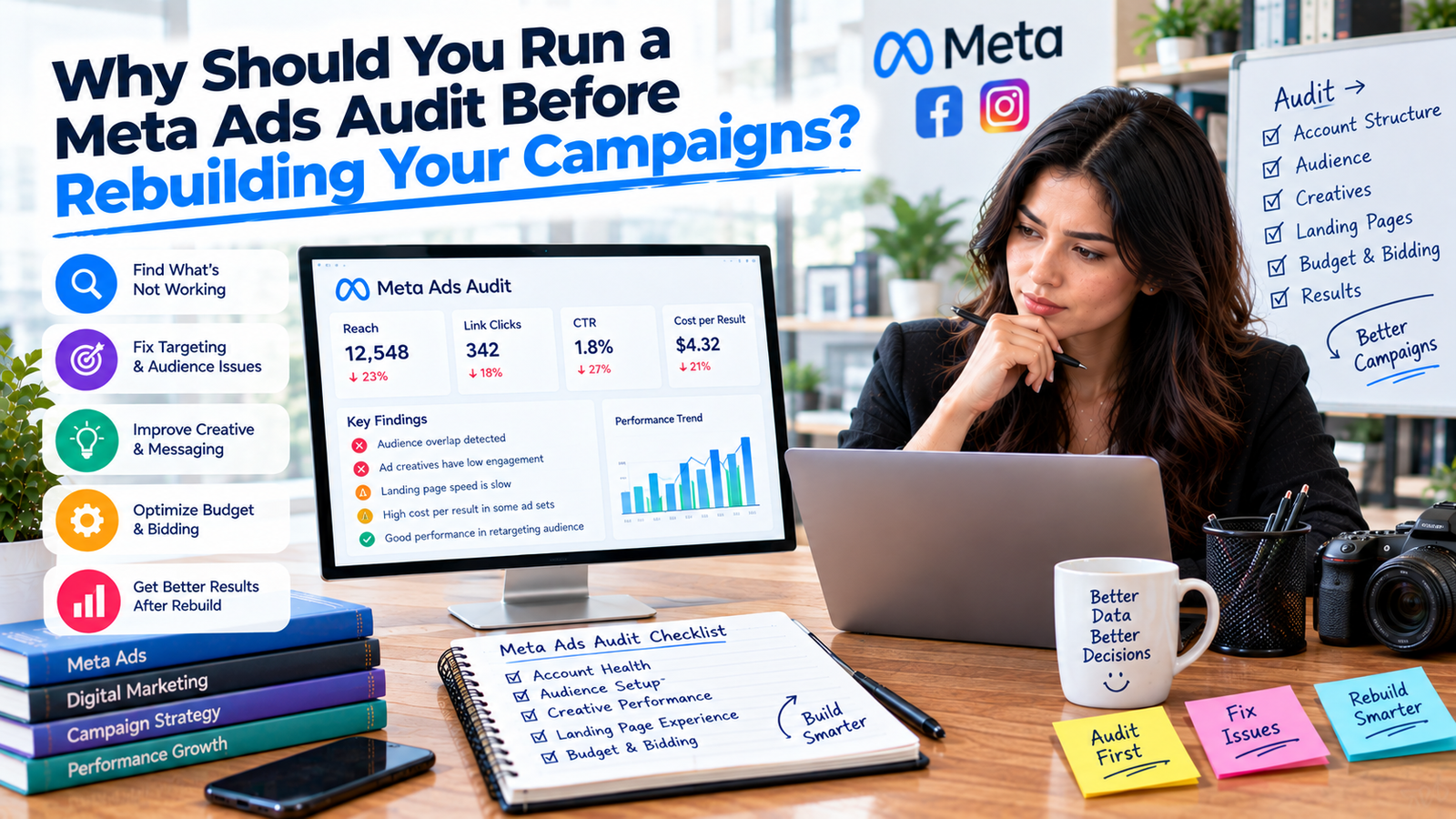
When Meta advertising performance declines, the first reaction is often to rebuild everything. Businesses create new campaigns, change audiences, increase budgets, and replace advertisements without first identifying the real problem.
These changes may create temporary movement, but they can also remove useful campaign history and introduce several new variables at once. If results improve or decline, the team may not know which change caused it.
A structured Meta Ads audit examines the existing system before major decisions are made. It reviews tracking, account structure, creative performance, audience delivery, offers, landing pages, and business results.
The objective is not simply to find mistakes. It is to understand what should be protected, what needs improvement, and what should be tested next.
What Is a Meta Ads Audit?
A Meta Ads audit is a detailed review of an advertising account and its connection with the wider customer journey.
It examines how campaigns are organized, which conversion events guide optimization, how budgets are allocated, and whether advertisements attract suitable customers.
The audit should also look beyond Ads Manager. A campaign can produce affordable traffic while the landing page, checkout, lead form, or sales process prevents conversions.
An experienced Meta advertising strategist considers both platform data and business outcomes before recommending changes.
Why Random Campaign Changes Create More Confusion
Changing several parts of a campaign at the same time makes performance difficult to diagnose.
Imagine that a business changes the audience, advertisement, landing page, and budget on the same day. If sales improve, the team cannot confidently identify the reason. If results decline, it faces the same problem.
An audit creates a clear starting point. It documents what is running, what has already been tested, and where performance begins to weaken.
This allows the business to prioritize changes instead of rebuilding the account based on assumptions. It also helps prevent a team from repeating unsuccessful tests that were completed months earlier but never recorded properly.
Start by Checking Tracking and Attribution
Campaign decisions are only as reliable as the information supporting them.
An audit should confirm that important events are recorded correctly. These may include product views, form submissions, purchases, booked calls, subscriptions, or qualified leads.
Missing events can make successful campaigns appear weak. Duplicated events may make performance look stronger than it really is.
The review should examine the Meta Pixel, Conversions API, domain settings, event priorities, website analytics, and customer records where appropriate.
Platform reports will not always match other systems because attribution methods differ. The goal is not to force identical numbers. It is to create enough reliable evidence for useful decisions.
Review Campaign Structure and Budget Allocation
A complicated account is not automatically a sophisticated account.
Too many campaigns and ad sets can divide the budget into small sections, making it difficult for each one to collect enough conversion data. On the other hand, combining unrelated audiences, countries, products, or objectives may reduce control.
The right structure depends on budget, conversion volume, business model, and testing needs.
An audit should identify which campaigns are responsible for testing, scaling, retargeting, or specific offers. It should also check whether spending reflects the business’s current priorities.
Professional ad account audit services can help turn this information into a practical action plan rather than a list of disconnected platform observations.
Examine Creative Performance by Concept
Creative analysis should go further than identifying the advertisement with the lowest cost per result.
Each asset should be labelled according to its concept, hook, customer problem, benefit, format, offer, and level of awareness. This makes it possible to understand why certain advertisements attract attention or support conversions.
For example, product demonstrations may consistently outperform general lifestyle videos. Objection-focused ads may generate fewer clicks but bring more qualified leads. A customer story may work well for warm audiences but struggle with people unfamiliar with the product.
A review of the brand’s advertising creative portfolio can also reveal whether the account has enough variety to support continued testing and higher spending.
The aim is to find repeatable insights—not simply copy one winning ad until it becomes ineffective.
Check for Creative Fatigue and Audience Saturation
An advertisement can lose performance when the same audience sees it repeatedly. This is often described as creative fatigue, but frequency alone does not tell the complete story.
The audit should compare frequency with cost changes, conversion rate, click quality, and audience size. A higher frequency may be normal in retargeting but more concerning in a broad prospecting campaign.
Creative fatigue can also occur because the message is no longer competitive or relevant. Producing a new visual with the same hook may not solve the problem.
The stronger response is to test new angles, customer problems, proof, formats, or offers while retaining useful lessons from previous campaigns.
Evaluate Audiences Without Overcomplicating Targeting
Audience settings matter, but they are not the only factor controlling who responds to an advertisement.
The creative message also acts as a targeting signal. A specific problem, use case, or benefit can attract suitable customers while discouraging irrelevant clicks.
An audit should compare broad, interest-based, custom, and lookalike audiences where enough data exists. It should examine overlap, exclusions, audience size, and placement performance without making decisions based on one short period.
Narrow targeting is not automatically more accurate, and broad targeting is not suitable in every situation. The best approach depends on the offer, location, budget, data quality, and customer profile.
Inspect the Offer and Landing-Page Experience
A campaign can attract the right people and still fail after the click.
The landing page should continue the promise made in the advertisement. Its headline, offer, visuals, and call to action should feel connected to the original message.
An audit may identify slow mobile loading, confusing navigation, weak proof, hidden pricing conditions, long forms, or a difficult checkout process.
The offer itself also needs attention. Customers should understand what they receive, who it is for, why it matters, and what they should do next.
No campaign structure can fully repair an offer that provides unclear value. Advertising and conversion experience must be evaluated together.
Connect Lead Data With Sales Quality
For lead-generation businesses, the cheapest lead is not necessarily the most valuable.
An audit should compare form submissions with contact rate, qualification, appointments, attendance, closed customers, and revenue. This reveals whether campaigns attract people who can realistically purchase.
Sales-team feedback provides context that platform reports cannot show. It may reveal that leads misunderstand the service, cannot afford it, live outside the supported area, or are not ready to make a decision.
Relevant campaign case studies can demonstrate why advertising performance should be measured differently across ecommerce, SaaS, and lead-generation models.
Compare Platform Results With Business Profitability
Return on ad spend can be useful, but it does not include every business expense.
Product cost, fulfilment, refunds, discounts, software, creative production, and sales commissions may significantly affect real profitability.
The audit should compare advertising results with customer acquisition cost, average order value, margin, repeat purchases, and customer lifetime value where data is available.
Verified client results and reviews can provide further context on how strategy, creative work, and execution contribute to broader growth outcomes.
A campaign should not be scaled only because one platform reports an attractive number.
Turn Audit Findings Into a Prioritized Plan
A useful audit ends with clear actions.
Problems should be organized by impact and urgency. Broken tracking or a failed checkout may need immediate attention. Creative variety, landing-page tests, and account restructuring may follow in planned stages.
Each recommendation should explain what needs to change, why it matters, and how success will be evaluated.
This prevents the team from attempting every improvement at once. It also creates a baseline for comparing future results with the account’s previous condition.
Frequently Asked Questions
How often should a Meta Ads audit be completed?
A detailed audit may be useful before major scaling, after a sustained performance decline, when tracking changes, or when a new team takes control of the account.
Does an audit require campaigns to be paused?
Not always. Campaigns can often continue while the account is reviewed. Immediate changes may be required only when tracking, spending, or website problems create serious risk.
Can a new advertising account be audited?
Yes. A new account can be reviewed for tracking, structure, naming, audience planning, and creative readiness before significant spending begins.
How long does a Meta Ads audit take?
The timeline depends on account size, campaign history, tracking complexity, and access to sales or ecommerce data.
What should happen after the audit?
The business should receive a prioritized plan covering urgent fixes, testing opportunities, scaling requirements, and suitable performance measures.
Final Thoughts
Rebuilding campaigns without understanding the existing problems can waste budget and remove valuable learning.
A Meta Ads audit creates a clearer picture of tracking, structure, creative performance, audience delivery, landing pages, and profitability. It helps the business distinguish between platform problems and weaknesses elsewhere in the customer journey.
With a prioritized plan, campaign changes become controlled tests rather than random reactions, giving the account a stronger foundation for sustainable improvement.
Ready to Implement This in Your Ad Account?
Stop guessing why your Meta ads are stalling. Let's look inside your Ads Manager together and find the high-leverage growth bottlenecks.
Book 15-Minute Strategy Call →