
News
How Can Inconsistent Conversion Definitions Make Paid Campaign Reports Impossible to Trust?
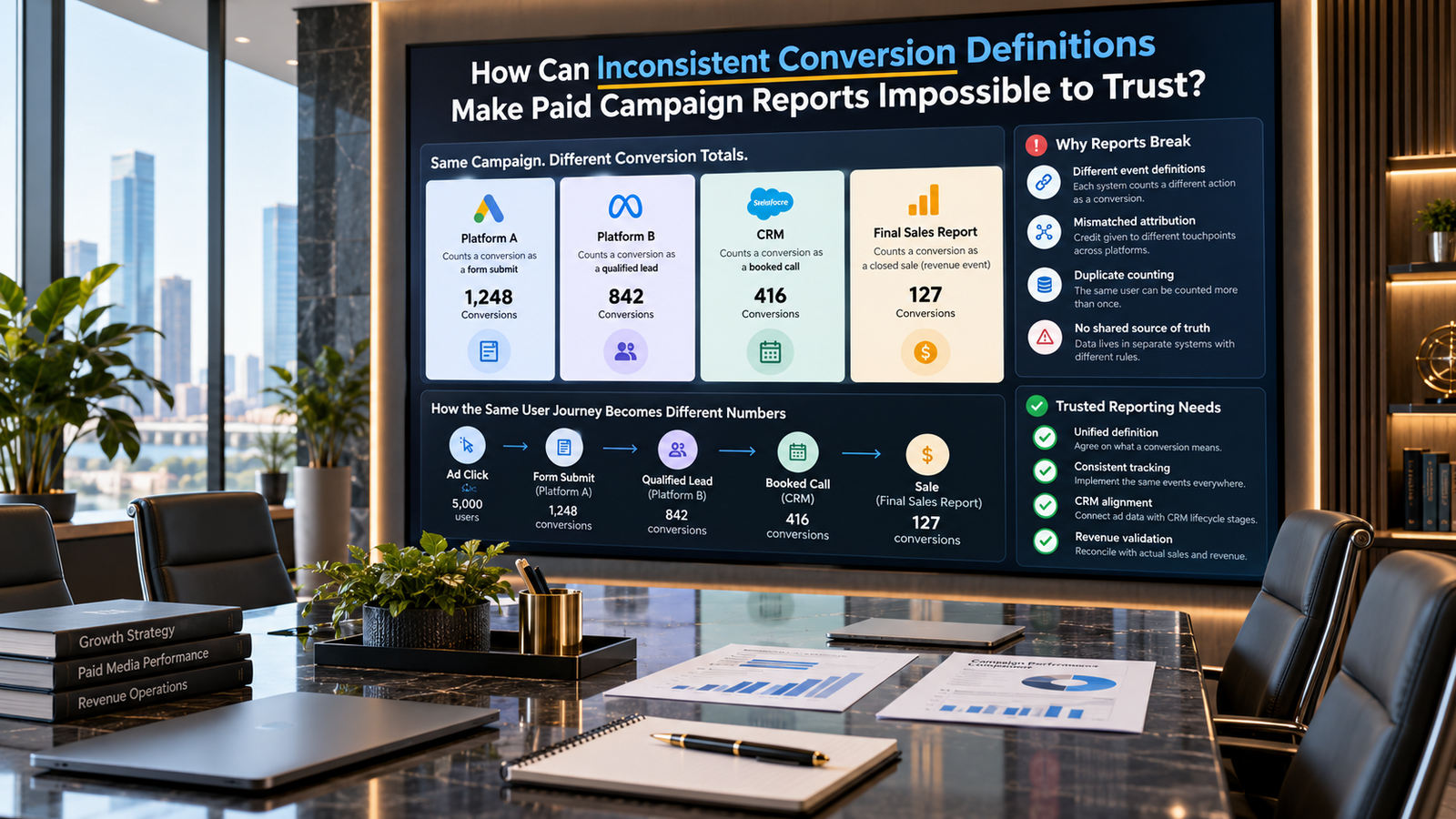
Paid advertising reports can look accurate while telling completely different stories. One platform may count a form submission as a conversion, the CRM may count only qualified enquiries, and the sales team may consider a conversion complete only after receiving payment.
When these definitions are mixed together, marketers cannot compare campaigns fairly. A campaign may appear successful inside an advertising account but generate few genuine opportunities. Another may look expensive because its conversions are measured later in the customer journey.
Conversion event standardization gives every team a shared method for naming, tracking, and evaluating customer actions. It creates more reliable reports and helps businesses make better budget decisions.
What Is a Conversion Event?
A conversion event is an action that shows a person has moved forward in the customer journey. Depending on the business, this action may include:
· Submitting a lead form
· Booking a consultation
· Calling the business
· Starting a free trial
· Adding a product to the cart
· Completing a purchase
· Becoming a qualified sales opportunity
· Renewing a subscription
The problem begins when teams use the word “conversion” without explaining which action it represents.
A performance marketing specialist may report landing-page leads, while the sales team discusses paying customers. Both figures may be correct, but they measure different stages.
Why Do Conversion Definitions Become Inconsistent?
Conversion definitions often develop separately across platforms and departments.
Marketing may configure events according to what is easy to track. Sales may create CRM stages based on its own workflow. Finance may recognize revenue only when payment is received.
Advertising platforms can add further confusion by using different attribution windows, event names, and counting methods. One tool may count multiple actions from the same person, while another records only one customer.
Problems also appear when old tracking events remain active after a website or sales process changes. A thank-you-page visit may continue to register as a lead even though the form has been replaced or the page can be accessed without completing it.
Define Primary and Secondary Conversions
Not every useful action should have the same importance.
Primary conversions represent the main outcome a campaign is expected to generate. For a lead-generation campaign, this could be a qualified enquiry or booked consultation. For ecommerce, it is usually a completed purchase.
Secondary conversions provide supporting information. These may include video views, email sign-ups, brochure downloads, product-page visits, or add-to-cart actions.
Secondary actions can help explain user behaviour, but they should not be presented as if they carry the same value as primary outcomes.
A clear digital marketing strategy separates meaningful business results from engagement signals that simply show interest.
Create a Shared Conversion Dictionary
A conversion dictionary provides an agreed definition for every important event.
Each entry should explain:
· The event name
· The exact action that triggers it
· Where it is recorded
· Whether it is primary or secondary
· Which team owns the data
· Whether duplicate actions are allowed
· When the event should be considered valid
For example, a “qualified lead” might be defined as a contact who has a genuine need, fits the service area, meets a minimum budget requirement, and agrees to speak with sales.
This prevents one representative from marking every enquiry as qualified while another applies much stricter standards.
Use the Same Names Across Systems
Event names should remain as consistent as possible across the website, analytics software, advertising platforms, CRM, and reporting dashboards.
If the website records “form_submit,” the advertising platform reports “lead,” and the CRM uses “new opportunity,” the team must know whether these labels describe the same action or different stages.
A simple naming system reduces confusion. Names such as “lead_submitted,” “lead_qualified,” “appointment_booked,” and “sale_completed” clearly show progression.
Businesses using multiple paid advertising services should apply the same naming logic across platforms so results can be compared more accurately.
Prevent Duplicate and Accidental Conversions
Duplicate conversions can make campaign performance appear stronger than it is.
A conversion may be counted more than once when a user refreshes a confirmation page, submits several forms, clicks both a call button and a message button, or completes the same event on different devices.
Accidental conversions can also occur when employees test forms, bots submit enquiries, or tracking codes fire before an action is completed.
Teams should test conversion triggers regularly and establish rules for duplicate activity. A campaign report should make it clear whether it counts events, unique leads, qualified prospects, or customers.
Examples from a verified advertising portfolio are easier to evaluate when the reported results use clear and consistent definitions.
Connect Early Actions With Sales Outcomes
Advertising platforms often optimize around the earliest measurable action because it happens quickly. However, a submitted form does not always become a qualified lead, and a booked appointment does not always become a customer.
Businesses should connect campaign information with CRM outcomes whenever possible. The reporting journey may look like this:
1. Advertisement click
2. Lead submitted
3. Lead contacted
4. Lead qualified
5. Appointment attended
6. Proposal accepted
7. Payment received
Tracking these stages reveals where value is created or lost.
A campaign generating fewer leads may produce more revenue if those leads progress through the sales process at a stronger rate.
Account for Different Attribution Rules
Even standardized events can produce different totals when platforms use different attribution rules.
An advertising platform may claim a conversion after someone clicks an ad and purchases several days later. An analytics tool may credit the final website visit, while the CRM records only the original lead source.
Instead of expecting every system to show identical numbers, teams should document how each system assigns credit.
A useful report can display platform-attributed conversions alongside CRM-qualified leads and confirmed sales. This provides multiple perspectives without pretending that all figures measure the same thing.
Reviewing relevant campaign case studies can help businesses understand why reporting context matters as much as the final number.
Audit Conversion Events Regularly
Conversion tracking should not be treated as a one-time setup.
Website updates, new forms, CRM changes, consent tools, payment systems, and platform updates can affect how events are recorded. A conversion that worked correctly several months ago may now be duplicated, missing, or assigned the wrong value.
A regular audit should check:
· Whether each event still fires correctly
· Whether event names match the conversion dictionary
· Whether duplicate actions are being filtered
· Whether test leads are excluded
· Whether revenue values are accurate
· Whether CRM stages reflect the current sales process
This protects reporting quality before incorrect data influences major budget decisions.
Give Every Report Clear Labels
Reports should use specific labels instead of general terms such as “results” or “conversions.”
For example, use:
· Form submissions
· Unique leads
· Qualified leads
· Attended appointments
· Completed purchases
· Retained revenue
Clear labels allow decision-makers to understand exactly what they are reviewing. They also make performance comparisons more meaningful over time.
Published client results and reviews may build confidence, but internal campaign reporting still needs precise definitions and verified data.
Final Thoughts
Conversion event standardization creates a common language between marketing, sales, finance, and analytics teams. It explains which actions matter, when they are counted, and how they connect to revenue.
Businesses should define primary and secondary conversions, maintain a shared event dictionary, prevent duplicates, connect leads with sales outcomes, and audit tracking regularly.
When every report uses clear definitions, teams can compare campaigns fairly, identify genuine performance problems, and allocate advertising budgets with greater confidence.
Frequently Asked Questions
What is conversion event standardization?
It is the process of creating consistent names, definitions, rules, and values for conversion actions across advertising platforms, analytics tools, websites, and CRM systems.
Should form submissions and qualified leads both be counted?
Yes, but they should be reported as separate stages. A form submission shows initial interest, while a qualified lead meets the business’s agreed suitability criteria.
Why do advertising platforms report different conversion totals?
Platforms may use different attribution windows, identity methods, counting rules, time zones, and conversion triggers. Differences should be documented rather than automatically treated as errors.
How often should conversion tracking be audited?
A basic audit should be completed after major website, CRM, or campaign changes. Regular quarterly checks are also useful, while high-spend accounts may require more frequent reviews.
Who should define conversion events?
Marketing, sales, finance, analytics, and technical teams should agree on the definitions. Shared ownership ensures that campaign metrics reflect both advertising activity and genuine business outcomes.
Ready to Implement This in Your Ad Account?
Stop guessing why your Meta ads are stalling. Let's look inside your Ads Manager together and find the high-leverage growth bottlenecks.
Book 15-Minute Strategy Call →