
News
Why Can Discount-Heavy Paid Campaigns Grow Revenue While Quietly Shrinking Profit?
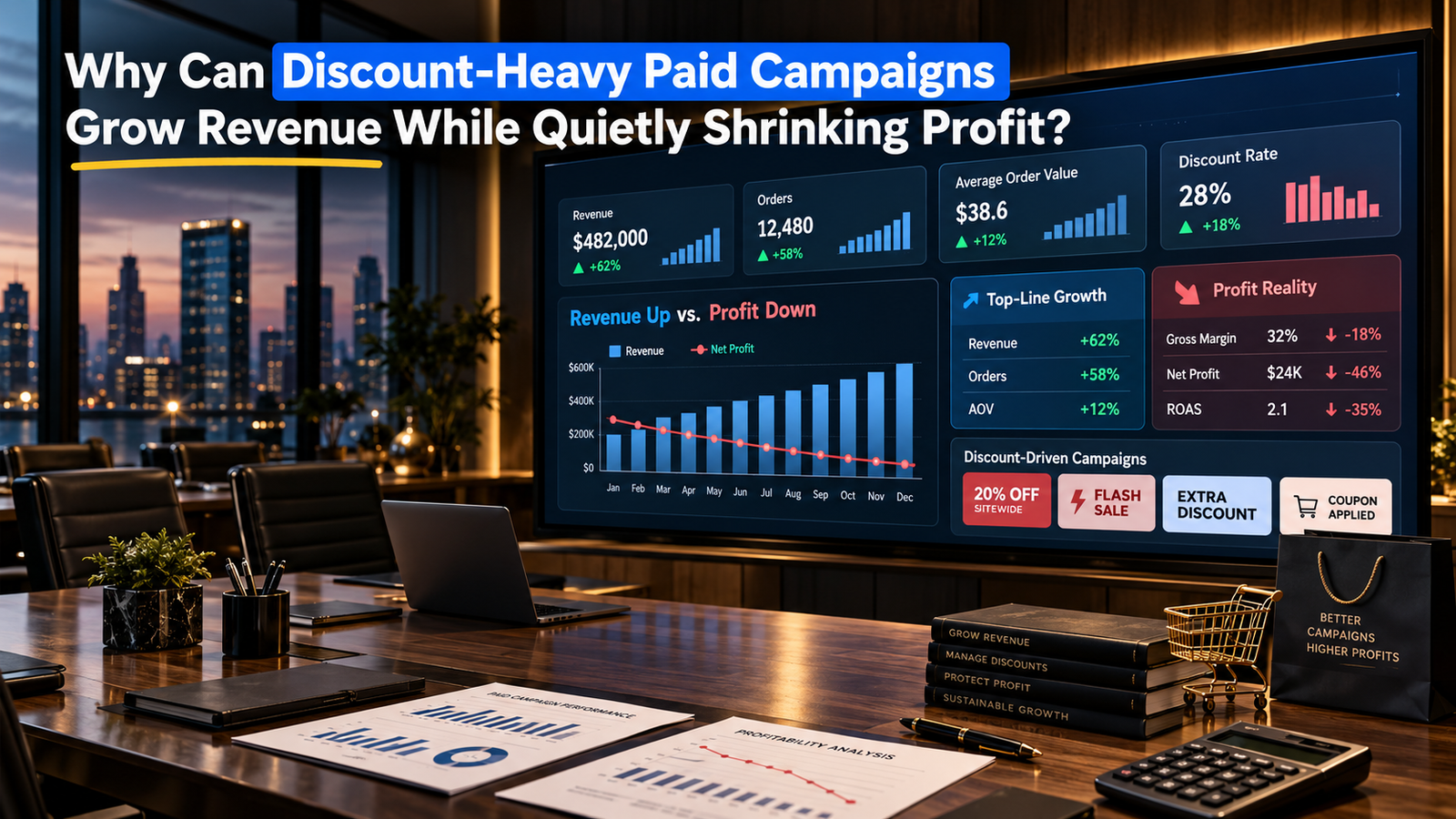
Discounts can make a paid advertising campaign look highly successful. Click-through rates improve, conversion volume increases, and revenue rises. The advertising platform may even report a stronger return on ad spend.
However, these positive numbers do not always mean that the business is earning more money.
A campaign can generate record sales while producing less profit because every discounted order contributes less money after advertising, fulfilment, payment processing, and other costs. Understanding discount profitability in paid advertising helps businesses avoid scaling promotions that look impressive inside an advertising dashboard but weaken their financial position.
An experienced performance marketing strategist evaluates more than conversion volume. The real question is whether each campaign creates profitable, sustainable customer growth.
Why Discounts Produce Attractive Campaign Results
Discounts reduce the amount of resistance a customer feels before purchasing. An undecided shopper may act quickly when presented with 15% off, free delivery, a limited-time bundle, or a special first-order price.
These incentives can improve several campaign metrics:
· Higher click-through rates
· More completed purchases
· Lower cost per acquisition
· Faster conversion decisions
· Increased short-term revenue
· Stronger reported return on ad spend
These results are valuable, but they only show one part of the commercial picture.
Suppose a product normally sells for $100 and costs $55 to manufacture and deliver. Before advertising, the order contributes $45 toward overhead and profit. If the business offers a 20% discount, revenue falls to $80, but the $55 cost may remain unchanged. The available contribution drops from $45 to $25 before advertising costs are deducted.
If acquiring the customer costs $22, the discounted order produces only $3 before considering payment fees, returns, customer service, or overhead. Revenue has been generated, but very little profit remains.
Revenue, ROAS, and Profit Are Different Metrics
Revenue measures the amount customers spend. Return on ad spend compares that revenue with advertising costs. Neither metric automatically reveals net profit.
A campaign generating $40,000 from $10,000 in advertising spend has a 4.0 ROAS. That may appear healthy. However, if discounts, product costs, shipping, transaction fees, and refunds consume $32,000, the campaign has created a loss.
Businesses should calculate contribution margin rather than relying only on platform-reported revenue. A digital marketing strategist should therefore connect advertising reports with reliable commercial data.
A useful calculation is:
Net campaign contribution = collected revenue − discounts − product costs − fulfilment costs − payment fees − returns − advertising spend
This calculation provides a more realistic view of whether a promotion deserves additional budget.
How Discount Depth Changes Acquisition Economics
A small discount may increase conversion rates enough to compensate for the lost margin. A deeper discount requires a much larger improvement in conversion performance.
For example, reducing a price by 10% does not mean that sales only need to increase by 10% to preserve profit. Because fixed product and fulfilment costs remain, the required increase may be considerably higher.
This is why businesses should test different promotion levels instead of immediately offering the largest possible discount. Their paid advertising services should support controlled experiments that compare revenue, acquisition cost, contribution margin, and customer quality.
Useful variations may include:
· 10% versus 20% discounts
· Free delivery versus a price reduction
· Product bundles versus storewide promotions
· Gifts with purchase versus cash discounts
· New-customer offers versus public offers
· Minimum-spend incentives
The promotion generating the most purchases is not necessarily the one producing the strongest business result.
Discount Campaigns Can Attract Lower-Quality Customers
Aggressive promotions may attract people who primarily buy when prices are reduced. These customers can increase first-order sales but may never return at the normal price.
This matters when a business accepts a low initial profit because it expects customers to make future purchases. If discounted buyers have weak repeat-purchase rates, that assumption becomes dangerous.
Companies should compare promotional customers with full-price customers using:
· Repeat-purchase rate
· Average order value
· Time until the second order
· Refund or cancellation rate
· Customer support costs
· Lifetime contribution margin
Reviewing an advertising portfolio can also help businesses understand how different campaign structures and creative angles support quality acquisition rather than temporary sales volume.
Platforms May Optimize Toward Discount-Dependent Buyers
Advertising platforms learn from conversion data. If a business continually promotes discounts, the algorithm may find more users who respond to promotional pricing.
That can create a difficult cycle. Discount campaigns perform well, full-price campaigns struggle, and the business becomes increasingly dependent on promotions to maintain revenue.
The platform is not necessarily making a mistake. It is optimizing for the conversion event it was given. If every purchase is treated equally, it cannot distinguish between a profitable full-price customer and a low-margin promotional customer.
Businesses can improve decision-making by sending more meaningful data back to their advertising systems. Purchase value, product margin, qualified customer status, refunds, and repeat revenue can provide a clearer signal than raw order volume alone.
Relevant campaign case studies can demonstrate why campaign success should be measured through business outcomes rather than isolated platform metrics.
Promotions Can Cannibalize Full-Price Demand
Not every discounted order is an additional sale. Some customers would have purchased without the promotion but use the discount because it is available.
This is known as cannibalization. The business records the order as a promotional success, even though the discount simply reduced the margin on a sale that was already likely to happen.
Businesses can investigate this by comparing promotional periods with normal sales baselines. Geographic holdout tests, audience exclusions, new-customer restrictions, and matched time-period comparisons can reveal how much demand was genuinely created.
Existing customers should also be analysed separately. Giving a large discount to loyal customers may increase short-term order volume while unnecessarily reducing revenue the business could have earned at full price.
How to Measure Discount Profitability in Paid Advertising
Before launching a promotion, define the minimum acceptable contribution from each order. This threshold should account for variable costs and advertising spend.
During the campaign, monitor:
Profit per Order
Determine how much money remains after the discount, product cost, shipping, fees, and media spend.
New-Customer Acquisition Cost
Separate new buyers from returning customers. A promotion that mainly attracts existing customers should not be evaluated as a customer acquisition campaign.
Incremental Revenue
Estimate how much revenue the promotion created beyond what would normally have occurred.
Customer Lifetime Value
Track whether promotional customers return, how quickly they reorder, and whether they purchase without another discount.
Refund and Cancellation Rate
High promotional volume may create rushed purchases that later become refunds, exchanges, chargebacks, or cancelled subscriptions.
Comparing these outcomes with verified client results and reviews helps keep expectations connected to sustainable performance rather than headline metrics.
Alternatives to Blanket Discounts
Businesses do not always need to reduce prices across every product and audience. More controlled incentives can protect margin while still encouraging action.
Possible alternatives include bundles that raise average order value, free delivery above a minimum spend, limited bonuses, loyalty rewards, product-specific promotions, and personalised offers for genuinely hesitant customers.
Strong creative can also reduce the need for heavy discounting. Demonstrations, customer proof, clear benefits, risk reversal, and better explanation of the product’s value may improve conversion rates without lowering the price.
Final Thoughts
Discounts can support acquisition, inventory movement, and seasonal demand, but higher revenue does not automatically mean higher profit. Businesses must evaluate discount depth, contribution margin, customer quality, repeat behaviour, and incremental demand.
The purpose of studying discount profitability in paid advertising is not to eliminate promotions. It is to ensure that every offer has a clear financial role. A well-designed discount campaign should attract valuable customers, protect sufficient margin, and support long-term growth instead of creating attractive numbers that hide declining profitability.
Frequently Asked Questions
Can discounts improve paid advertising performance?
Yes. Discounts can increase click-through rates and conversions by reducing purchase hesitation. However, the additional sales must produce enough contribution margin to justify the reduced selling price.
What is the best discount percentage for paid campaigns?
There is no universal percentage. The right discount depends on product margin, acquisition cost, customer lifetime value, fulfilment expenses, and the conversion improvement created by the offer.
Why can a high-ROAS discount campaign still lose money?
ROAS compares advertising spend with revenue but usually ignores product costs, discounts, shipping, payment fees, refunds, and overhead. Once these expenses are included, the campaign may be unprofitable.
Should new and returning customers receive the same discount?
Not always. New-customer offers can support acquisition, while automatically discounting returning customers may reduce margin on purchases that would have occurred without an incentive.
How often should promotional campaigns be reviewed?
Performance should be monitored during the campaign, but a complete review should also happen after refunds, cancellations, and repeat-purchase data become available. This provides a more accurate view of the promotion’s actual value.
Ready to Implement This in Your Ad Account?
Stop guessing why your Meta ads are stalling. Let's look inside your Ads Manager together and find the high-leverage growth bottlenecks.
Book 15-Minute Strategy Call →