News
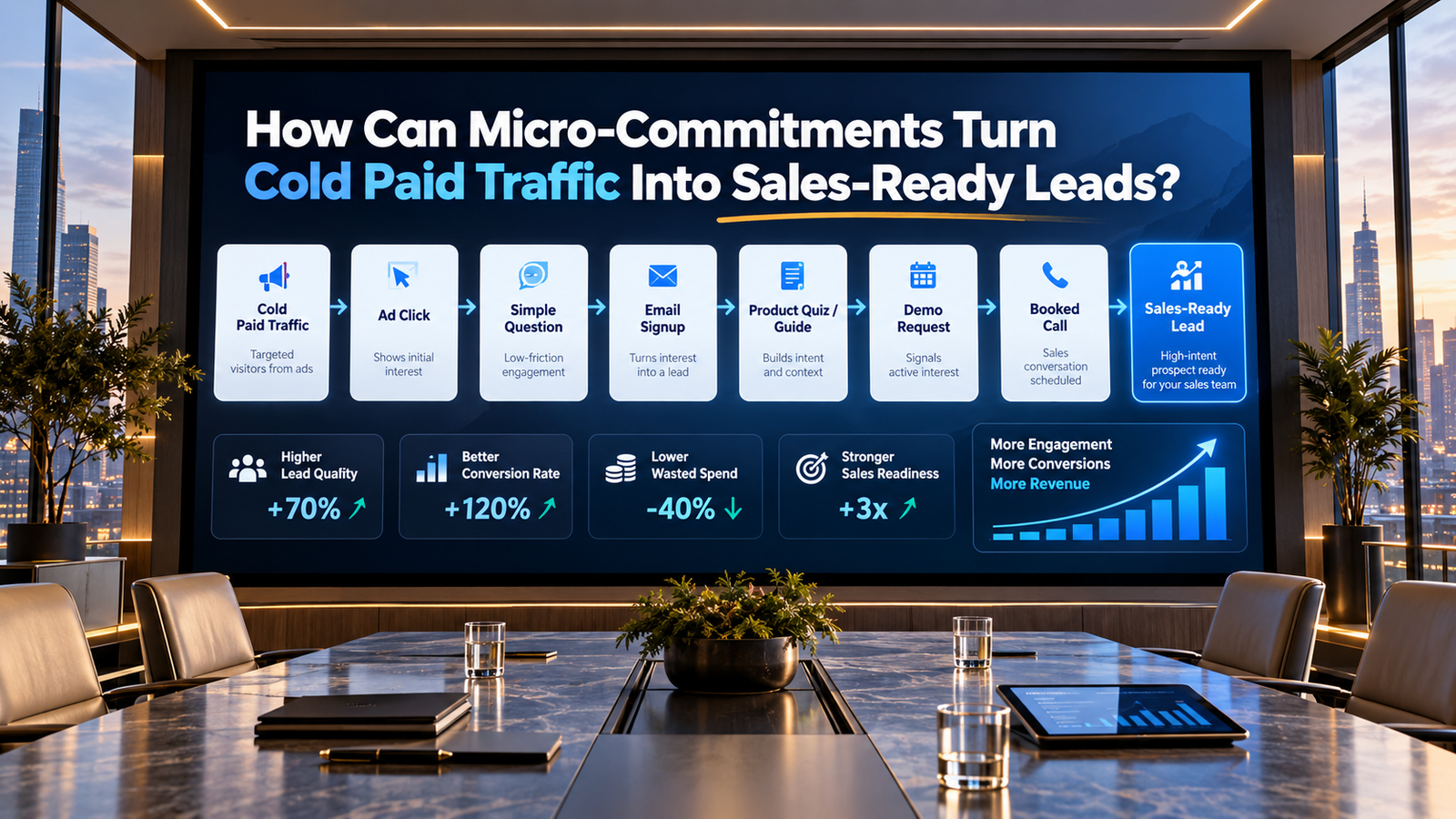
How Can Micro-Commitments Turn Cold Paid Traffic Into Sales-Ready Leads?
Paid advertising often asks people to make a major decision too quickly. A visitor discovers a brand for the first time and is immediately expected to purchase, request a proposal, book a consultation, or submit a detailed form.
This approach may work for people who already understand the problem and trust the solution. However, cold audiences usually need more information before they are ready to act.
Micro-commitments solve this problem by replacing one large decision with a sequence of smaller, easier actions. A well-designed micro-commitment lead generation strategy can build trust, identify buying intent, and move paid traffic toward conversion without relying on aggressive sales pressure.
What Is a Micro-Commitment in Marketing?
A micro-commitment is a small action that requires limited time, effort, or risk from a potential customer.
Examples include:
· Watching a short product demonstration
· Answering one qualification question
· Selecting a business goal
· Using a calculator or assessment
· Viewing a customer success story
· Downloading a practical checklist
· Requesting a price estimate
· Starting a short quiz
· Comparing available options
Each action helps the prospect learn something while giving the business a useful behavioural signal.
The objective is not to add unnecessary steps. It is to create a more natural path between discovering an advertisement and making a meaningful buying decision.
Why Cold Paid Traffic Often Needs Smaller Steps
Cold audiences may recognize a problem without understanding the available solution. They may also be uncertain about price, suitability, expected outcomes, or the credibility of the advertiser.
When an advertisement asks these users to book a call immediately, the request can feel larger than the value they have received.
A strong creative strategist considers the level of commitment the audience is prepared to make at each stage. Instead of treating every click as a purchase opportunity, the strategy helps customers progress from awareness to understanding and then to action.
This approach is especially useful for SaaS products, professional services, high-value ecommerce items, and lead generation offers with longer consideration periods.
Why Micro-Commitments Improve Lead Quality
A conventional lead form may capture contact details without showing how interested or suitable the person is. Some users submit forms casually, while others do not understand what will happen next.
Micro-commitments introduce useful context before the final conversion.
A prospect who completes an assessment, reviews a service comparison, and examines relevant proof has demonstrated more intent than someone who clicked an advertisement and immediately entered an email address.
This does not mean every funnel should contain several pages. Even one meaningful interaction can help separate curiosity from serious interest.
Understanding customer motivation through professional audience research and creative strategy helps businesses choose micro-commitments that are genuinely useful instead of creating artificial engagement.
A Practical Micro-Commitment Framework
1. Start With a Low-Risk Action
The first action should feel easy and relevant to the advertisement.
A marketing consultant could invite visitors to identify their biggest acquisition problem. A software company could offer a short workflow assessment. An ecommerce brand could help customers choose the right product variation.
The user should receive immediate value from participating. If the first step feels like disguised data collection, trust can decline rather than improve.
2. Use the Response to Personalize the Next Step
The next message should reflect what the user selected.
For example, a visitor who identifies lead quality as the main problem should see information about qualification, message alignment, and sales readiness. Someone who selects high acquisition costs should receive guidance about creative performance, offer strength, and conversion friction.
Personalization does not need to be technically complex. Clear pathways based on two or three common customer needs can make the experience feel more relevant.
3. Introduce Proof at the Right Moment
Proof becomes more persuasive when it matches the concern currently being considered.
A general testimonial may provide reassurance, but a relevant example showing how a similar problem was addressed is usually more useful. Businesses can use performance creative examples to demonstrate different advertising approaches without interrupting the customer journey with an immediate sales request.
Proof should support the decision, not distract the visitor with unrelated achievements.
4. Make the Final Conversion Feel Like the Next Logical Step
After completing smaller actions, the prospect should understand why the main conversion is valuable.
A strategy-call form can explain what will be reviewed during the conversation. A demo request can clarify what the user will see. A product page can show which option matches the preferences already selected.
The final call to action should continue the journey rather than suddenly changing its direction.
5. Keep the Journey Short and Purposeful
Micro-commitments should reduce psychological friction, not create operational friction.
Every step must have a reason. If a question does not personalize the experience, qualify the lead, or improve the final recommendation, it may not be necessary.
The best journey is not always the one with the most interactions. It is the one that gives customers enough confidence to make an informed decision.
Where Micro-Commitment Funnels Usually Fail
One common mistake is asking too many questions before providing value. A long quiz can feel like another lead form, especially when the result is generic.
Another problem is hiding the real intention of the funnel. If users believe they are receiving an instant assessment but are forced to book a call before seeing any result, they may feel misled.
Businesses also create friction when the advertisement and follow-up experience use different messages. If the ad promises a quick price estimate but the landing page offers a general consultation, the user may abandon the journey.
A structured review of campaign case studies can help marketers understand how creative, offers, landing pages, and qualification processes must support the same objective.
How Creative Should Support Each Commitment
Different stages require different creative messages.
The first advertisement may focus on a recognizable problem. Retargeting content can explain the solution, answer objections, or show a relevant demonstration. The final message can present a clear action to prospects who have already shown interest.
This sequence allows creative to perform different jobs rather than repeating the same sales message.
The professional background of Zohaib Raja as a performance media buyer also demonstrates why campaign structure and creative strategy should be planned together. Media buying determines who receives the message, while creative determines whether the next action feels relevant.
How to Measure Micro-Commitment Performance
Marketers should measure more than the number of completed first steps.
Important metrics include:
· Cost per meaningful interaction
· Completion rate for each stage
· Final lead conversion rate
· Cost per qualified lead
· Appointment attendance rate
· Lead-to-customer conversion rate
· Time from first click to conversion
· Revenue generated from qualified leads
A high quiz completion rate is not valuable if participants rarely become customers. Similarly, a smaller number of interactions may still produce better results when those users show stronger buying intent.
Businesses should compare campaign data with actual client results and reviews to understand which engagement signals are connected to genuine commercial outcomes.
Final Thoughts
Micro-commitments help cold audiences move forward without being pressured into making an immediate major decision. They give prospects useful information, allow businesses to recognize intent, and create a clearer path from advertisement to conversion.
The strategy works best when every step provides value and naturally prepares the customer for the next action. Businesses should not add more funnel stages simply to collect additional data. They should remove uncertainty in the smallest number of meaningful steps.
When creative, qualification, proof, and landing-page messaging work together, micro-commitments can turn uncertain paid traffic into better-informed, sales-ready leads.
Frequently Asked Questions
1. What is the main purpose of a micro-commitment?
Its purpose is to help a potential customer take a small, low-risk action before being asked to complete a larger conversion such as a purchase or consultation booking.
2. Do micro-commitments increase the length of a sales funnel?
They can add a step, but they may shorten the overall decision process by answering questions and building confidence before the sales conversation begins.
3. Which businesses benefit most from this strategy?
It is particularly useful for SaaS, professional services, lead generation, high-value ecommerce, and businesses whose customers require education before purchasing.
4. Can a quiz be used as a micro-commitment?
Yes, provided the quiz is short, relevant, and gives the participant a genuinely useful result instead of functioning only as a hidden lead form.
5. How should businesses test a micro-commitment funnel?
Start with one useful interaction and compare its qualified-lead rate, conversion rate, acquisition cost, and sales outcomes against the existing direct-conversion journey.
Ready to Implement This in Your Ad Account?
Stop guessing why your Meta ads are stalling. Let's look inside your Ads Manager together and find the high-leverage growth bottlenecks.
Book 15-Minute Strategy Call →