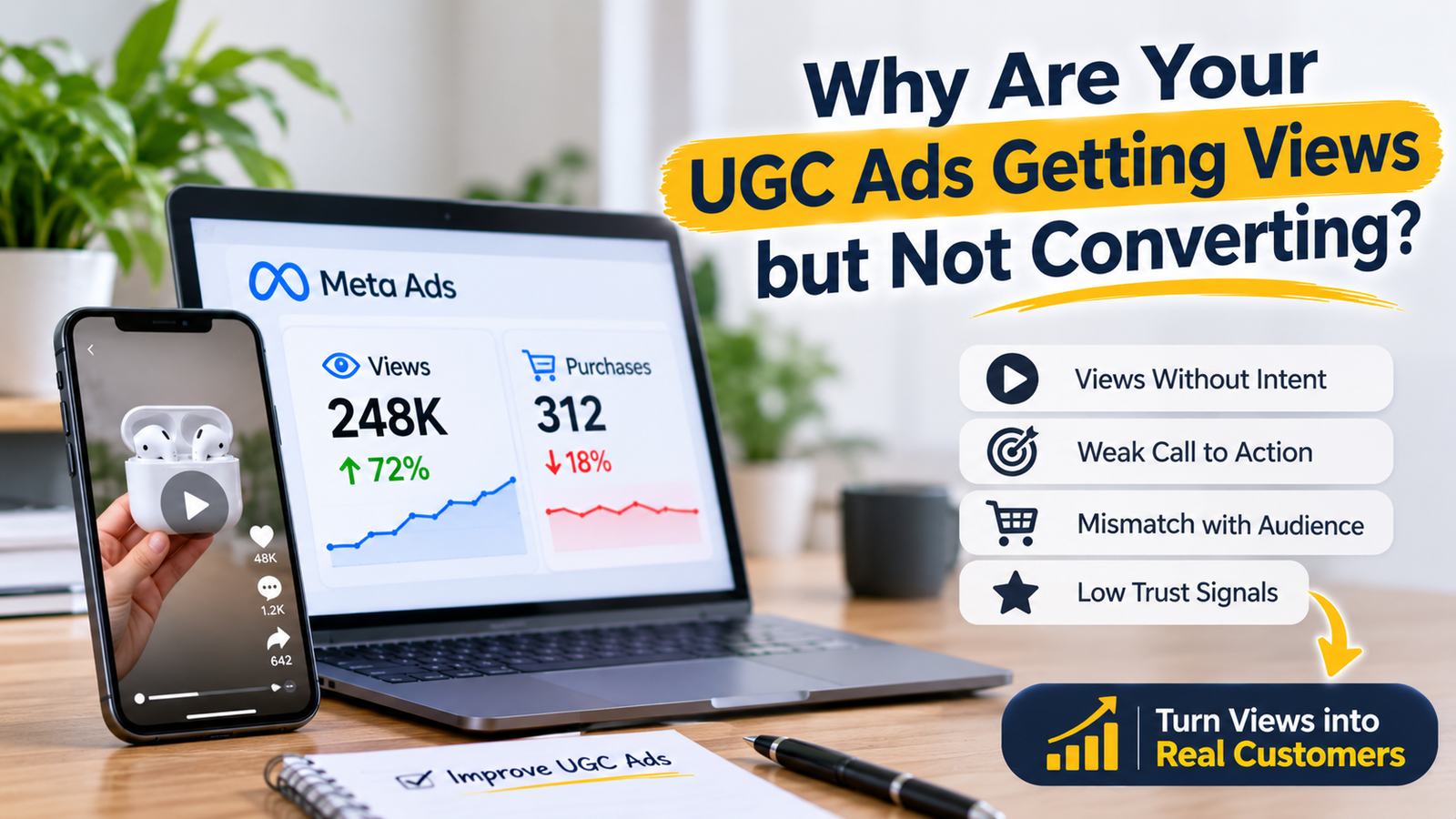
You launch a UGC video and it racks up thousands of views. The comments look friendly, but the purchase column stays empty. It feels like your UGC ads are working while your revenue says otherwise.
The good news is that views without sales is usually a diagnosable problem. It almost always traces back to four things: the hook, the script, the strategy behind the concept, and how you test. This guide walks through each one so you can find where your ads are leaking.
What Does “Views but No Sales” Actually Tell You?
Views only prove that an ad earned attention. They don’t show whether the right person watched, believed the message or had a reason to click. Before changing anything, look at where viewers drop off.
Reading the Drop-Off Points
- Low hook rate (few people watch past the first three seconds): the opening is the problem.
- Good hook rate, weak hold rate: the script loses people in the middle.
- Good watch time, low click-through: the offer or call to action isn’t landing.
- Strong clicks, no purchases: the issue is probably the landing page, price or tracking, not the creative.
Matching the symptom to the stage stops you from rewriting a good video when the real culprit is your product page.
Is Your Hook Killing Your UGC Ads?
If people scroll past in the first few seconds, nothing else in the ad matters. That is why hook development deserves its own process instead of being an afterthought.
What Makes a Strong Hook?
The strongest hooks name a specific person, problem or surprise. “I stopped buying overpriced skincare after I found this” will usually outperform “Check out this amazing product.”
Hook Styles Worth Testing
- Problem call-outs: “If your ads keep getting views but no sales, watch this.”
- Curiosity gaps: “The one thing I changed that cut my cost per purchase.”
- Social proof: “This has 2,000 five-star reviews, and here’s why.”
- Pattern interrupts: an unexpected visual or a blunt, unpolished opening line.
Write at least five hooks for every concept, covering the spoken line, the on-screen text and the opening visual. Then test them separately. Often the body of the ad is fine, and only the opening needs to change.
Does Your UGC Script Sound Like a Real Person?
Good UGC scriptwriting sounds like a friend recommending something, not a brochure being read aloud.
A Simple UGC Script Structure
A structure that works for most products is hook, problem, discovery, proof and offer. Keep each part to a sentence or two so the video stays short.
Rules for Scripts That Convert
- Use your customers’ words. Pull phrases from reviews, Reddit threads, support tickets and ad comments.
- Keep sentences short. If you wouldn’t say a line to a friend, rewrite it.
- One benefit per video. Trying to say everything makes the ad forgettable.
- One clear call to action. Tell viewers exactly what to do next.
Don’t over-script your creators. Give them the key beats and the must-say claims, then let them deliver the rest in their own voice. Authenticity is the whole point of UGC.
Who Decides Which Angle Your Ads Should Test?
Scripts are tactics. Choosing the audience, angle and offer behind each video is strategy, and this is the job of a creative strategist. Without someone owning it, you end up with ten nice videos that all say the same thing.
Build an Angle Matrix
Start with three audiences, three pain points and three formats, such as testimonial, demo and founder story. That gives you nine distinct concepts instead of nine variations of one idea. Static ads can also validate an angle cheaply before you invest in video production.
Match the Ad to the Landing Page
Make sure the ad’s promise matches the landing page headline. If the ad talks about saving time and the page talks about luxury, people leave. That mismatch looks like a creative problem but is really a message problem.
How Do You Run Creative Testing Without Wasting Budget?
Creative testing only produces learning if you change one variable at a time.
The Right Testing Order
- Angles first. The core reason to buy has the biggest impact.
- Hooks second. Same angle, different openings.
- Formats last. Same message, different styles.
How to Judge Winners
Give each ad enough spend to produce a meaningful signal before you judge it. A common rule of thumb is to let it spend a few times your target cost per purchase. Judge winners by cost per purchase or ROAS, not by hook rate or click-through rate alone. Those metrics help explain why an ad worked, but they don’t pick the winner.
Keep a simple log with the angle, hook, format, spend and cost per purchase. When something wins, iterate on it with new hooks and variations instead of starting from scratch. Over a few rounds, your account builds a library of proven angles rather than a pile of one-off guesses.
When Should You Hire a Meta Ads Specialist?
If you’ve fixed hooks, rewritten scripts and run structured tests but results still stall, the issue may sit deeper in account structure, tracking or the funnel. A Meta ads specialist can audit these areas and separate creative problems from conversion or attribution problems. This is most useful when you’re spending without learning anything, or when your team makes ads but nobody decides what to make next.
Frequently Asked Questions About UGC Ads
Why do my UGC ads get views but no sales?
The cause is usually a weak match between the hook, the offer and the landing page. Check where viewers drop off and where clicks fail to convert, then fix that stage.
How long should a UGC ad hook be?
Aim for the first one to three seconds. It should include a spoken line, on-screen text and a strong visual so it works even when the sound is off.
How many UGC ads should I test at once?
Start with three to five distinct concepts, each with a few hook variations. Too many ads split your budget and slow down learning.
Should I use UGC or polished brand creative?
Test both. UGC often performs well on Meta because it feels native to the feed, but your audience and product decide the winner.
How much should a UGC ad spend before I judge it?
There is no fixed number. Many advertisers wait until an ad has spent a few times their target cost per purchase before cutting it.
Do I need a creative strategist to run UGC ads?
Not strictly, but results are more consistent when someone owns research, angles and briefs. Without that, creative output tends to repeat itself.
Final Thoughts
UGC ads that get views but no sales are not a lost cause. They are a signal. Start by finding where viewers drop off, then fix the weakest stage: the hook, the script, the strategy or the testing process. Small improvements at each stage compound quickly.
If your ads still stall after these fixes, an outside review of your account can show where the leak is.
Ready to Implement This in Your Ad Account?
Stop guessing why your Meta ads are stalling. Let's look inside your Ads Manager together and find the high-leverage growth bottlenecks.
Book 15-Minute Strategy Call →