How Can Ecommerce Brands Turn Customer Objections Into Better Meta Ad Creative?
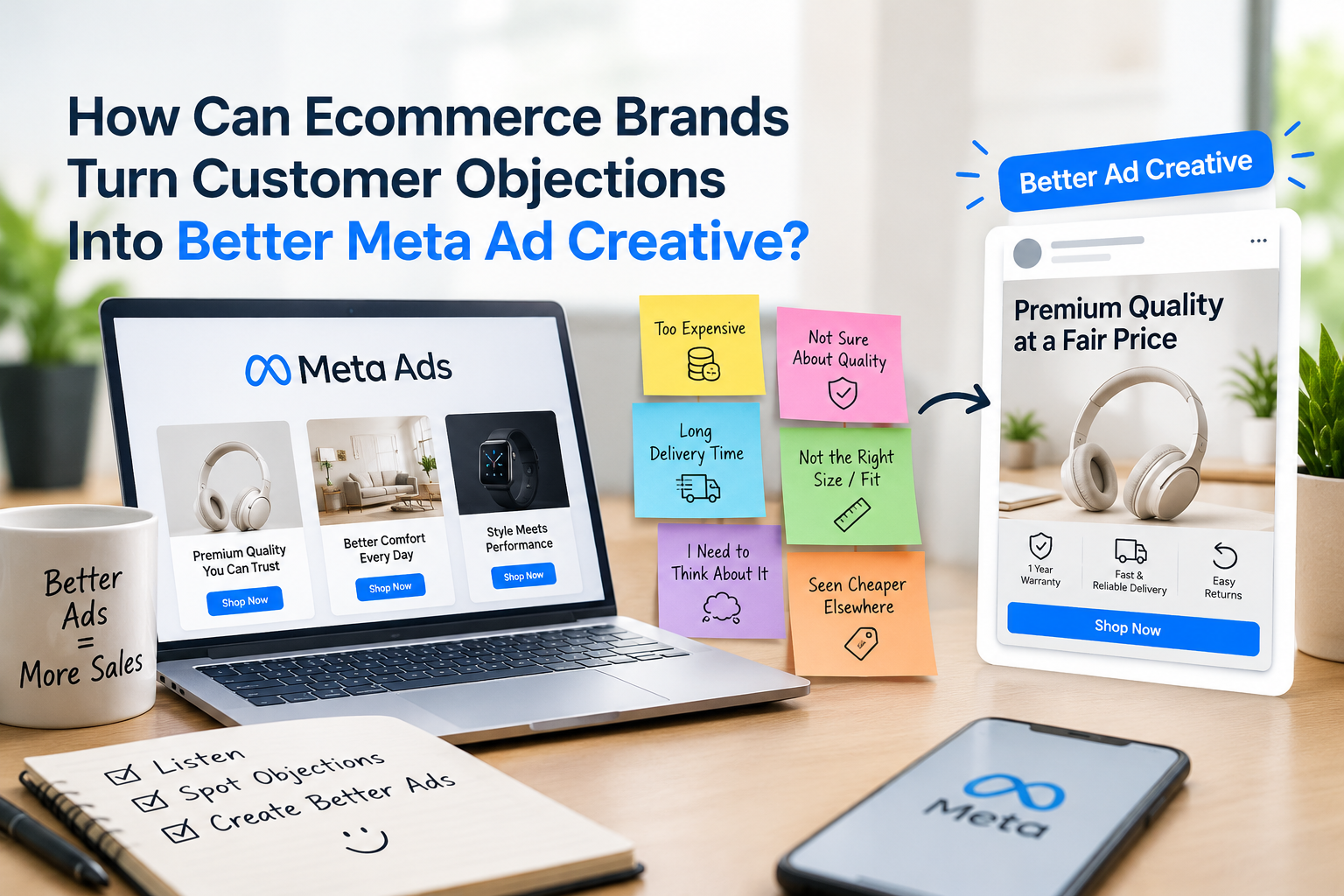
Most ecommerce customers do not buy immediately after seeing an advertisement. Before making a purchase, they usually have questions about the product, price, quality, delivery, trust, usability, or whether the product is actually right for them. These concerns are often treated as problems, but they can actually become some of the strongest ideas for Meta Ad creative.
A good creative strategy should not start with the question, “What kind of ad should we make next?” A better question is, “What is stopping the customer from buying?” Once a brand understands that, it becomes much easier to create ads that answer real customer concerns instead of producing random creative variations.
For example, imagine an ecommerce brand selling premium headphones. The brand may believe the main selling point is sound quality, but customers may be more concerned about comfort, battery life, durability, or whether the headphones are worth the higher price. Each of these concerns can become a different advertising angle.
If customers are worried about comfort, the creative can show someone using the headphones for several hours. If the concern is battery life, the ad can focus on how long the product lasts on a single charge. If price is the main objection, the creative can explain what makes the product different from cheaper alternatives.
This approach makes advertising more relevant because the message is connected to the customer’s actual decision-making process.
Where Can Brands Find Customer Objections?
Customer objections should not be based only on assumptions. The best ideas usually come directly from customers.
Product reviews are one of the strongest sources. Reviews often reveal what customers were worried about before buying and what convinced them afterward. Phrases such as “I wasn’t sure if this would work,” “I thought it might be difficult to use,” or “I was worried about the quality” can reveal useful creative opportunities.
Customer support conversations are another valuable source. Support teams regularly hear questions about product sizing, compatibility, delivery, setup, returns, quality, and usage. If the same question appears repeatedly, it may mean that many potential buyers have the same concern.
Brands should also look at comments on existing ads. Meta Ad comments often show what customers do not understand or what information is missing. A simple comment like “Does this work with Android?” could indicate that compatibility needs to be clearer in the next creative.
Useful sources can include:
-
Product reviews
-
Customer support conversations
-
Ad comments
-
Competitor reviews
-
Frequently asked questions
-
Post-purchase surveys
-
Sales team feedback
Competitor reviews can be especially useful because they show problems customers already experience in the category. If buyers complain that competitor products break quickly, durability may become a strong positioning angle. If customers complain that setup is difficult, ease of use could become a major creative opportunity.
Turn One Objection Into One Clear Creative Idea
Once an objection has been identified, the next step is to turn it into a clear advertising idea.
Suppose customers believe a product is difficult to install. Instead of making another general product video, the brand could create a short demonstration showing the complete installation process in three simple steps.
The creative hypothesis could be simple: if customers see that installation is easy, they may feel more confident about purchasing.
This is much stronger than simply saying, “Let’s make another video.”
The same approach can be used for different objections.
If the objection is price, the ad can explain value, durability, premium materials, or long-term savings.
If the objection is trust, the ad can use customer testimonials, reviews, founder videos, or behind-the-scenes content.
If the objection is effectiveness, the brand can use demonstrations, customer results, product comparisons, or proof-based creative.
If the objection is usability, a tutorial or UGC-style demonstration may work better than a traditional promotional video.
Different concerns require different creative formats.
Use Customer Objections to Build Better Hooks
The first few seconds of a Meta Ad are extremely important. A strong hook should make the right customer feel that the ad is relevant to them.
Customer objections can be turned into direct and useful hooks.
For example, if the objection is that a product looks difficult to use, the hook could be:
“Think this takes too long to set up? Watch this.”
If customers believe a premium product is too expensive, the hook could be:
“Why does this cost more than the cheaper version?”
If people are unsure whether the product is suitable for them, the hook could be:
“Who is this product actually made for?”
The goal is not to exaggerate or mislead. The hook should introduce a genuine customer question, and the rest of the ad should clearly answer it.
That creates a better connection between attention and persuasion.
Keep One Main Message Per Ad
A common mistake in ecommerce advertising is trying to explain everything in one creative.
An ad may start with a hook, explain six product features, show three reviews, mention a discount, discuss shipping, and then end with a guarantee. The customer receives a lot of information, but the main message becomes unclear.
A better approach is to give each ad one clear purpose.
One ad can focus on trust. Another can focus on price. Another can focus on ease of use. Another can focus on product quality.
This also improves creative testing because the team can understand which message is actually influencing performance.
Instead of testing completely random ads, the brand is testing different customer concerns and learning which ones matter most.
Match the Ad Message With the Landing Page
The customer journey should continue after the click.
If an advertisement focuses on durability, the landing page should provide information that supports the durability claim. If the ad highlights ease of use, the product page should clearly show how the product works.
Strong performance advertising and conversion optimization depends on message consistency.
If the customer clicks an ad because of one specific promise but lands on a page that does not support that promise, trust can drop quickly.
The ad and landing page should feel like parts of the same conversation.
Measure More Than Click-Through Rate
An ad that gets more clicks is not automatically a better ad.
The real goal is to attract customers who are more likely to take a valuable action.
Useful metrics can include:
-
Click-through rate
-
Landing page views
-
Add-to-cart rate
-
Conversion rate
-
Cost per acquisition
-
Average order value
-
Return on ad spend
The most important metric depends on the business model, but creative performance should always be connected to actual business outcomes.
My campaign case studies show why creative performance should be evaluated alongside customer acquisition costs, conversion performance, and overall campaign results rather than only platform engagement.
Build an Objection Library
One useful system for ecommerce brands is to maintain an objection library.
This can be a simple document or spreadsheet where the team records common customer concerns and connects them with creative ideas.
For example:
Price: too expensive, cheaper options available, unsure about value.
Trust: unfamiliar brand, worried about quality, unsure about returns.
Product Fit: sizing concerns, compatibility questions, unsure who the product is designed for.
Effectiveness: skeptical of claims, wants proof, unsure whether the product will solve the problem.
Convenience: difficult setup, complicated usage, slow delivery.
Each objection can then be connected with possible hooks, creative formats, customer quotes, supporting evidence, and previous test results.
Over time, this becomes a valuable source of ideas for future creative testing.
Final Thoughts
Customer objections are not just problems that sales teams need to overcome. They are also valuable creative insights.
Instead of continuously asking, “What ad should we make next?”, ecommerce brands should ask, “What is stopping the customer from buying?”
That single question can lead to stronger hooks, clearer demonstrations, better testimonials, more useful comparisons, and more focused creative testing.
The goal is not to answer every objection in one advertisement. The goal is to understand the customer’s most important concerns, create focused ads around those concerns, measure the results, and use that learning to improve the next round of creative.
Ready to Implement This in Your Ad Account?
Stop guessing why your Meta ads are stalling. Let's look inside your Ads Manager together and find the high-leverage growth bottlenecks.
Book 15-Minute Strategy Call →