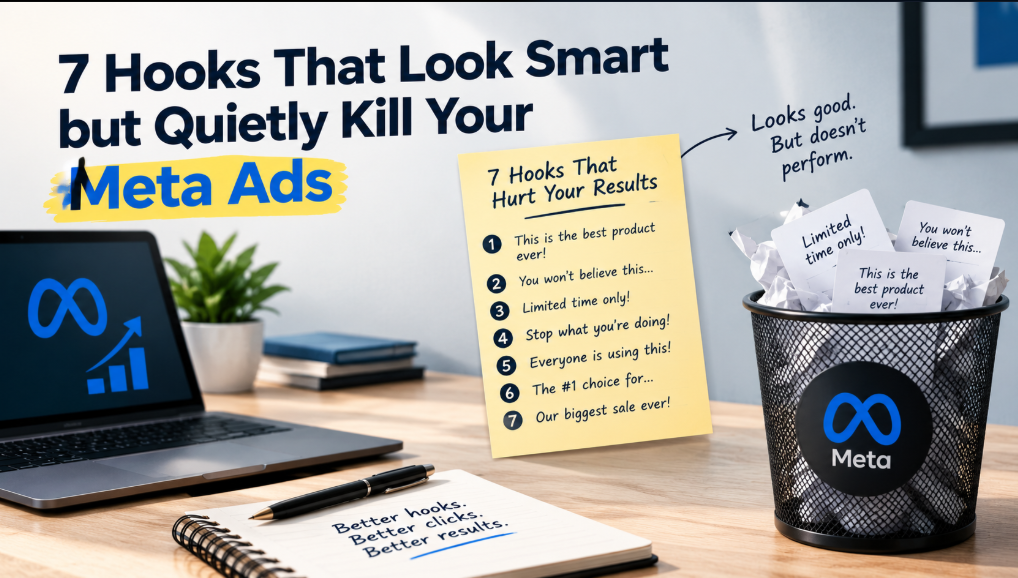
Here is an uncomfortable truth about ad hooks: the ones that get approved in meetings are often the ones that fail in the feed.
They sound clever. They look polished. Everyone on the team nods. Then the ad goes live, the hook rate sits in the basement and nobody can explain why. If you have ever run a Meta ads specialist audit on a struggling account, you will see the same seven mistakes again and again.
Below are those seven hooks, why they feel smart, why they fail and what to write instead.
1. The Clever Wordplay Hook
Puns and wordplay make marketers smile. The problem is that the person scrolling is not in a smiling-at-puns mood. They are half-looking at their phone while waiting for a bus. If they have to decode your joke, they are gone.
• Weak: “Tea-riffic news for your mornings.”
• Stronger: “I stopped buying coffee after finding this tea.”
Clear beats clever almost every time. Save the joke for later in the video, after you have earned attention.
2. The “Introducing” Hook
Brands love announcing themselves. Nobody scrolling cares. Starting with your product name tells the viewer that this is an ad, and they already have a reflex for skipping those.
• Weak: “Introducing the all-new Glow Serum.”
• Stronger: “My skin was flaking by lunch until I changed one thing.”
Lead with the viewer's problem, not your launch.
3. The Vague Big Promise
“Transform your life.” “Unlock your potential.” These sound inspiring and mean nothing. A promise that fits every product fits none of them.
• Weak: “Transform your skin today.”
• Stronger: “The dry patch on my cheek was gone in about a week.”
Specific details feel true. Big abstract words feel like advertising.
4. The Question Everyone Says Yes To
“Want better skin?” “Want to grow your business?” Of course they do. Everyone does. A question that costs nothing to answer does not earn attention.
• Weak: “Want to grow your store?”
• Stronger: “Why does your best ad stop working on day nine?”
A good question names a specific frustration the viewer is already feeling.
5. The Shock Hook That Has Nothing to Do With the Product
Someone throws a plate. A loud noise. A weird face. It stops the scroll, sure. But it attracts people who wanted entertainment, not your product, and the algorithm learns to show your ad to them.
Attention that does not connect to the offer is expensive. You pay for views that never become customers. If you want a pattern interrupt, make it relevant: show the problem itself, the messy before, the surprising result.
6. The Feature Dump
“Five-layer filtration, 12-hour battery, titanium finish.” Features describe a product. Hooks should describe a moment in the customer's life.
• Weak: “12-hour battery with fast charging.”
• Stronger: “I haven't charged this since Monday morning.”
Turn every feature into the situation it changes.
7. The Insider Jargon Hook
“CPMs are cooked, creative is the new targeting.” This kind of line feels sharp when marketers read it. A business owner scrolling past has no idea what it means. Jargon works for other marketers, not for buyers.
• Weak: “Andromeda just killed audience targeting.”
• Stronger: “If your ads need new angles every few weeks, here is why.”
Write as if you are explaining it to a friend in a different industry.
How to Check Your Own Hooks
The Five-Second Friend Test
Show your hook to someone outside your business for five seconds. Then ask what the ad is about and who it is for. If they cannot answer, the hook is not clear enough.
The Viewer's Problem Test
Read the hook and ask: does this describe my product or my customer's situation? If it is mostly about you, rewrite it.
A trained creative strategist runs this kind of check on every concept before it gets produced, because fixing a hook on paper costs nothing and fixing it after production costs real money.
Where Hooks Behave Differently
The same line can work on one platform and flop on another. On Facebook and Instagram, viewers often tolerate a slightly longer set-up. On TikTok, the opening needs to land almost instantly. If you are planning TikTok ads, assume the first second matters even more than you think.
Frequently Asked Questions
What makes a good hook for Meta ads?
A good hook is clear, specific and focused on the viewer's problem or desired result. It should be understood in a couple of seconds, even with the sound off.
How many hooks should I test per ad?
Three to five hooks per concept is a practical starting point. Keep the rest of the ad the same so you can see which opening works best.
Should my hook be funny or serious?
Neither is automatically better. Humor works when it is natural and relevant to the product, but clarity should always come first.
How do I know if my hook is the problem?
Check how many people watch past the opening seconds. If few viewers stay but those who do click and buy, the hook is probably the weak link.
Final Thoughts
Smart-sounding hooks impress colleagues. Clear hooks win customers. Before you launch your next batch of ads, read each opening line out loud and ask whether a stranger would care in two seconds.
If you want to see how this kind of thinking plays out in real accounts, browse the case studies and notice how often the winning idea was simpler than the one everyone loved at first.
Ready to Implement This in Your Ad Account?
Stop guessing why your Meta ads are stalling. Let's look inside your Ads Manager together and find the high-leverage growth bottlenecks.
Book 15-Minute Strategy Call →